
Cryptoasset firms registered — or registering — under MLR 2017 run financial-crime monitoring, sanctions screening and PS23/6 promotion checks from one platform, with the evidence trail FCA supervision demands.
14-day free trial · Take the tour
The dedicated E9 CMP chapter
The FCA-minimum baseline, evidenced
Guided prep + lifecycle tracking
MLR registration puts your firm under FCA financial-crime supervision. From that day, every control — due diligence, sanctions, promotions — is something you have to be able to prove, and the burden of proof sits with the firm.
The Reg 14A gateway expects a working programme — a risk assessment, a named MLRO, live controls — not a statement of intent. A file written by a consultant and left to age doesn’t survive the follow-up questions.
Since the crypto financial-promotions regime landed, risk warnings, cooling-off and approval requirements apply to every promotion — a post counts. Compliance has to be evidenced promotion by promotion, not asserted.
The business-wide risk assessment is meant to drive your controls — customer risk, jurisdiction risk, product risk. Written once at registration and never revisited, it drives nothing and proves less.
Screening runs, a hit fires, someone clears it in a message thread. In a Travel-Rule era, “who cleared this transfer, and why?” needs a record — not a memory.
The MLRO report and the REP-CRIM return get assembled by archaeology every year — numbers pulled from spreadsheets, narratives reconstructed from inboxes, weeks lost each cycle.
Cryptoasset and stablecoin policy is moving faster than any other perimeter, across 13 UK regulators. Missing the item that rewrites your obligations is how firms fall behind.
A named crypto chapter, a full financial-crime workspace and a guided registration path — for firms the FCA supervises under the money laundering regulations.
E9 Crypto Asset Firms — Registration & MLR puts 15 sector-specific checks into your monitoring plan, anchored to the Reg 14A registration regime, Regs 74C–74H, the PS23/6 promotion rules and the FATF Travel Rule. It sits alongside the ten B-prefix financial-crime chapters — 150 checks from AML framework and CDD through sanctions, SARs and the MLRO annual — inside the 1,139-template library.
For an MLR-registered firm this is the whole regime: a 36-control FCA-minimum checklist, a business-wide risk assessment with 27 pre-seeded high-risk jurisdictions, a sanctions workspace built for Travel-Rule-era screening, and a per-field audit trail behind every record.
FCA Applications covers MLR 2017 registrations alongside 74 regulated activity types — a requirements blueprint scoped to your application, an activity-scoped document checklist and a four-stage lifecycle that, for cryptoasset firms, ends in “Registered”.
Regulatory Intelligence carries a dedicated Crypto sector filter, keyword-mapped to cryptoasset, stablecoin and DeFi developments — and Otto scores each item’s relevance to your firm across the 13-regulator feed.
KYC files, wallet data, screening records — cryptoasset firms hold exactly the personal data the ICO cares about. The Data Protection module runs 13 live UK GDPR registers and a 30-control ICO checklist alongside your financial-crime programme.
The E9 crypto chapter lands in your programme complete — checks, owners, cadences and regulatory references — alongside the financial-crime chapters every MLR-supervised firm runs.
E9 Crypto Asset Firms — Registration & MLR, anchored to MLR 2017 Reg 14A, Regs 74C–74H, PS23/6 and the FATF Travel Rule.
The ten B-prefix chapters — AML framework, CDD, EDD and PEPs, monitoring, sanctions, SARs and the MLRO annual — the backbone of an MLR-supervised programme.
The crypto promotion rules run as scheduled E9 checks — risk warnings, cooling-off, record-keeping — with evidence attached to each check as it closes.
Complaints, breaches, gifts & entertainment and conflicts — every event your firm has to record, with named owners, due dates and maker-checker approval.
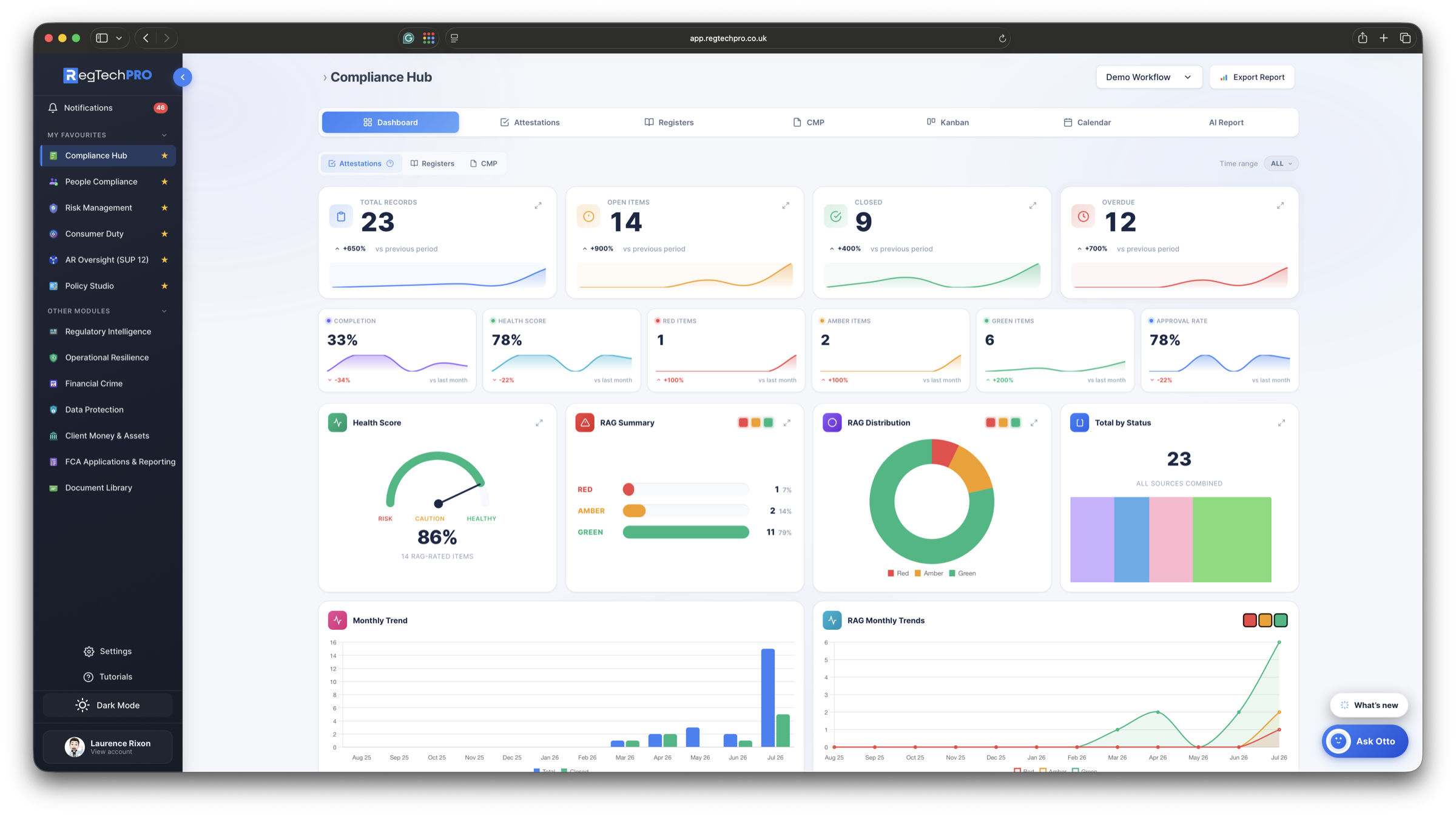
The MLRO’s landing surface. Live KPI tiles for open, closed and overdue tasks, completion and approval rates, an overall Health Score, RAG summary and monthly trends — every tile a one-click drill-down to the records underneath.
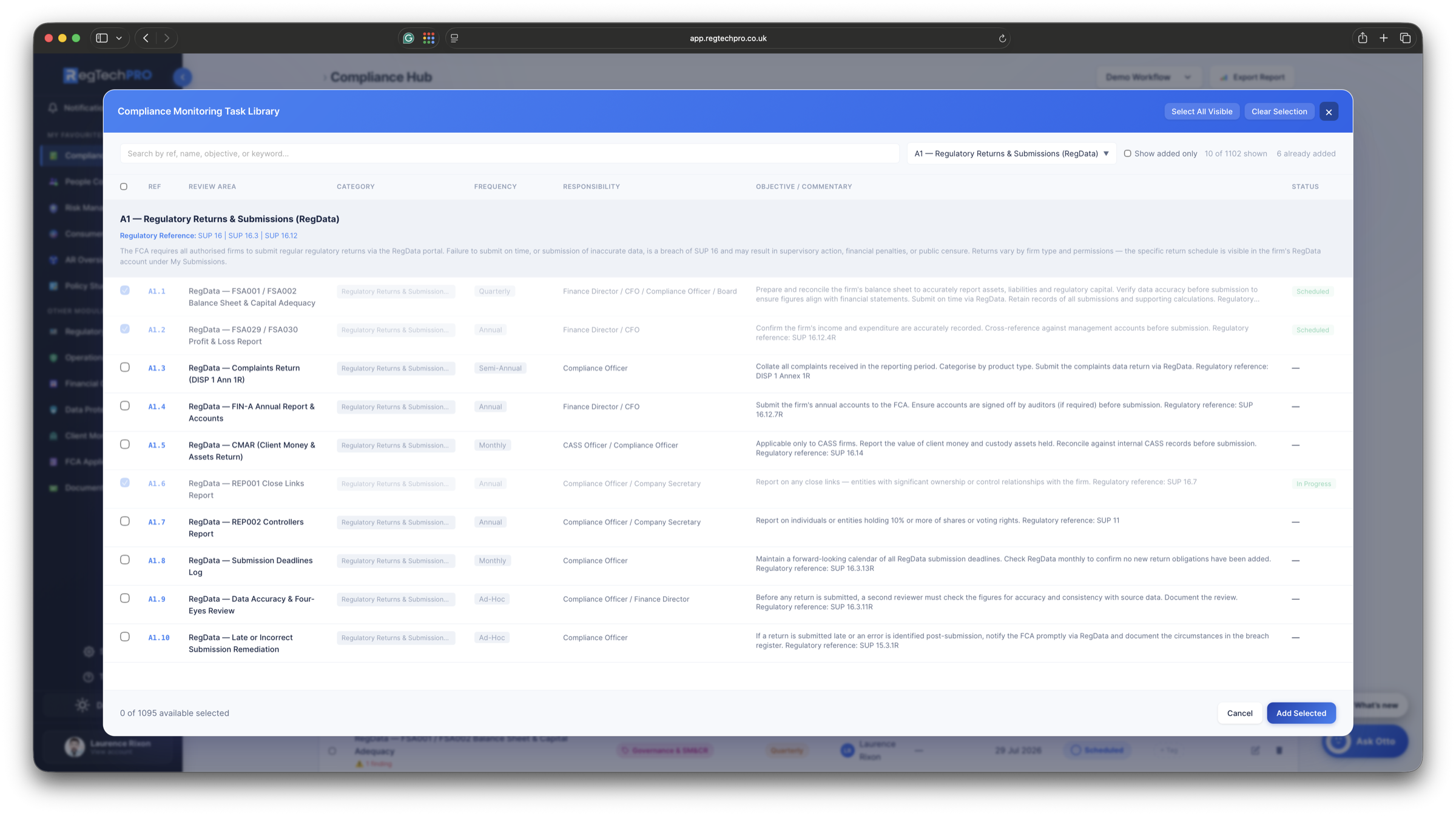
1,139 expert-built monitoring checks across 74 regulation-anchored categories — including the E9 crypto chapter and the ten B-prefix financial-crime chapters. Each template ships with a regulatory reference chain and plain-English guidance that pre-populates in-form.
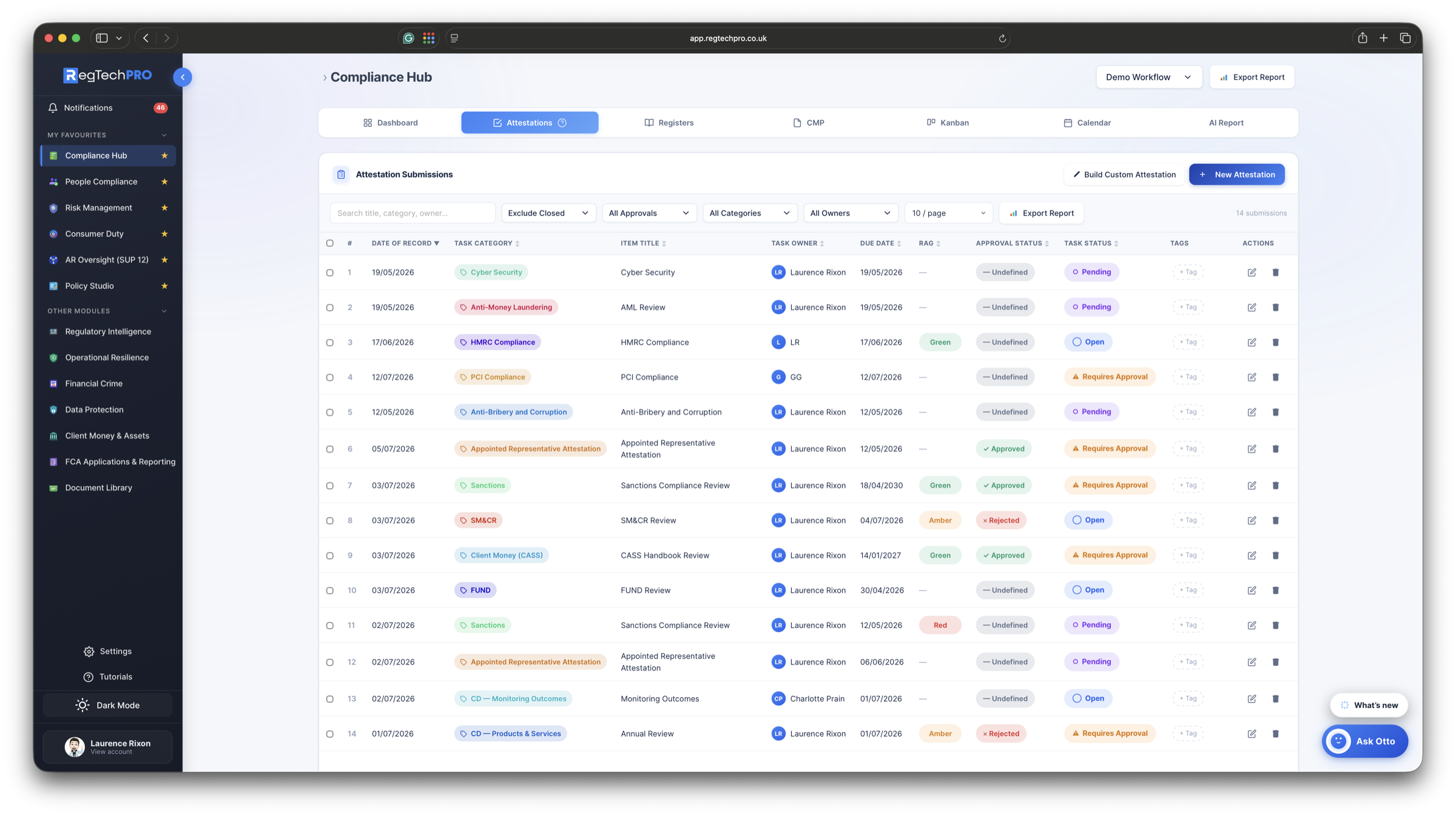
Every event your firm has to record, in one tracker. Complaints, breaches, gifts & entertainment and conflicts — status chips, named owners, due dates and the same maker-checker approval workflow throughout.
The FCA supervises cryptoasset firms for one thing: financial crime. The Financial Crime module holds the programme — controls, risk assessment, sanctions and MLRO reporting — with an audit trail behind every record.
The FCA-minimum control set with gap analysis — weaknesses become tracked actions with named owners and deadlines, not lines in a report.
A living BWRA with 27 pre-seeded high-risk jurisdictions — the document that drives your controls, kept current instead of written once at registration.
Your screening programme documented — lists, thresholds, cadence — with a hit log, frozen-assets and OFSI licence registers. Built for Travel-Rule-era screening.
The MLRO calendar, review SLAs and Otto’s report suite — MLRO Annual and REP-CRIM among four regulator-grade formats, drafted from live data.
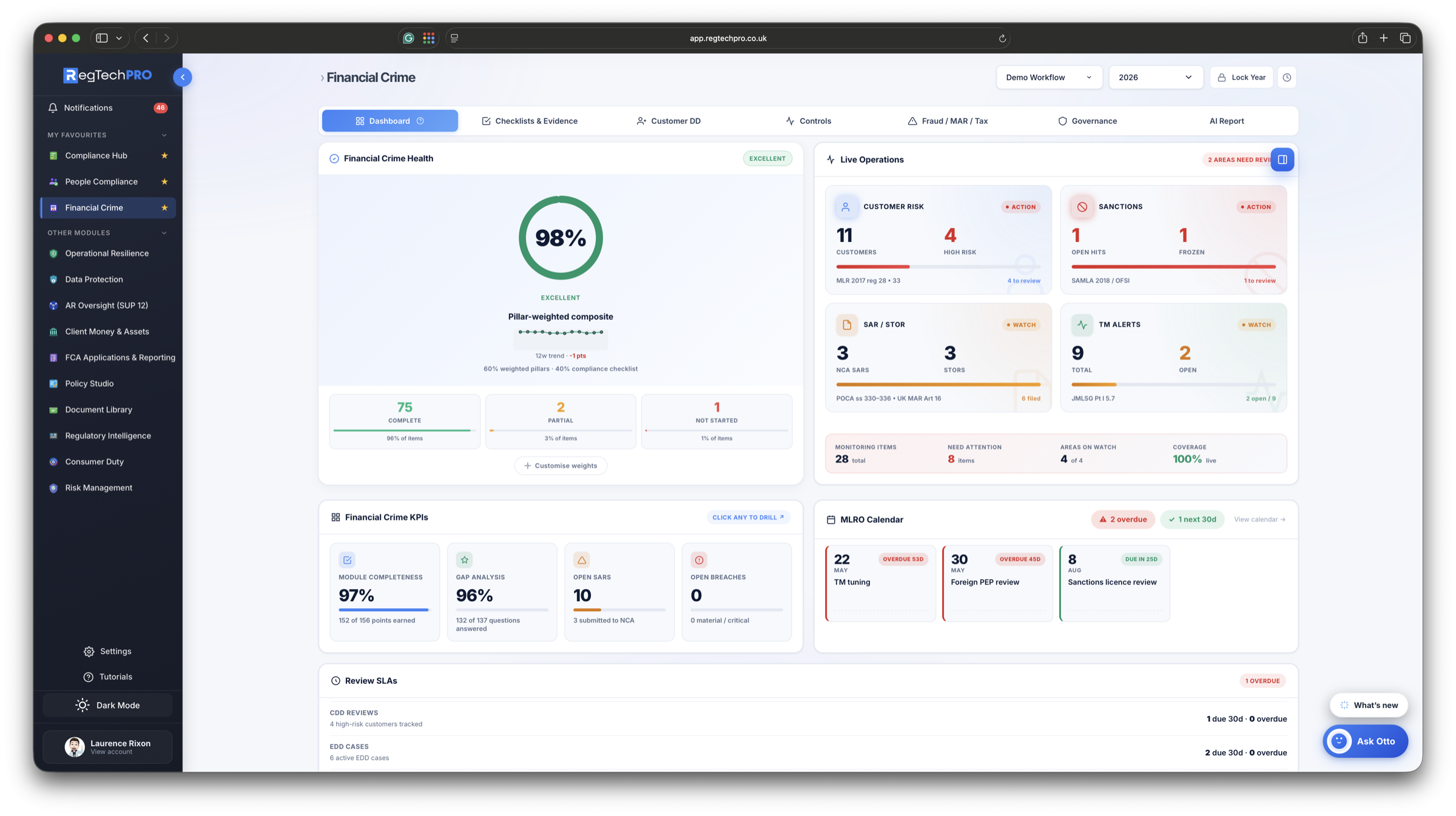
The MLRO’s morning glance. Financial Crime Health score, live operations across every regime, KPIs, the MLRO calendar and review SLAs — the whole function on one screen, every weakness one click from the work that fixes it.
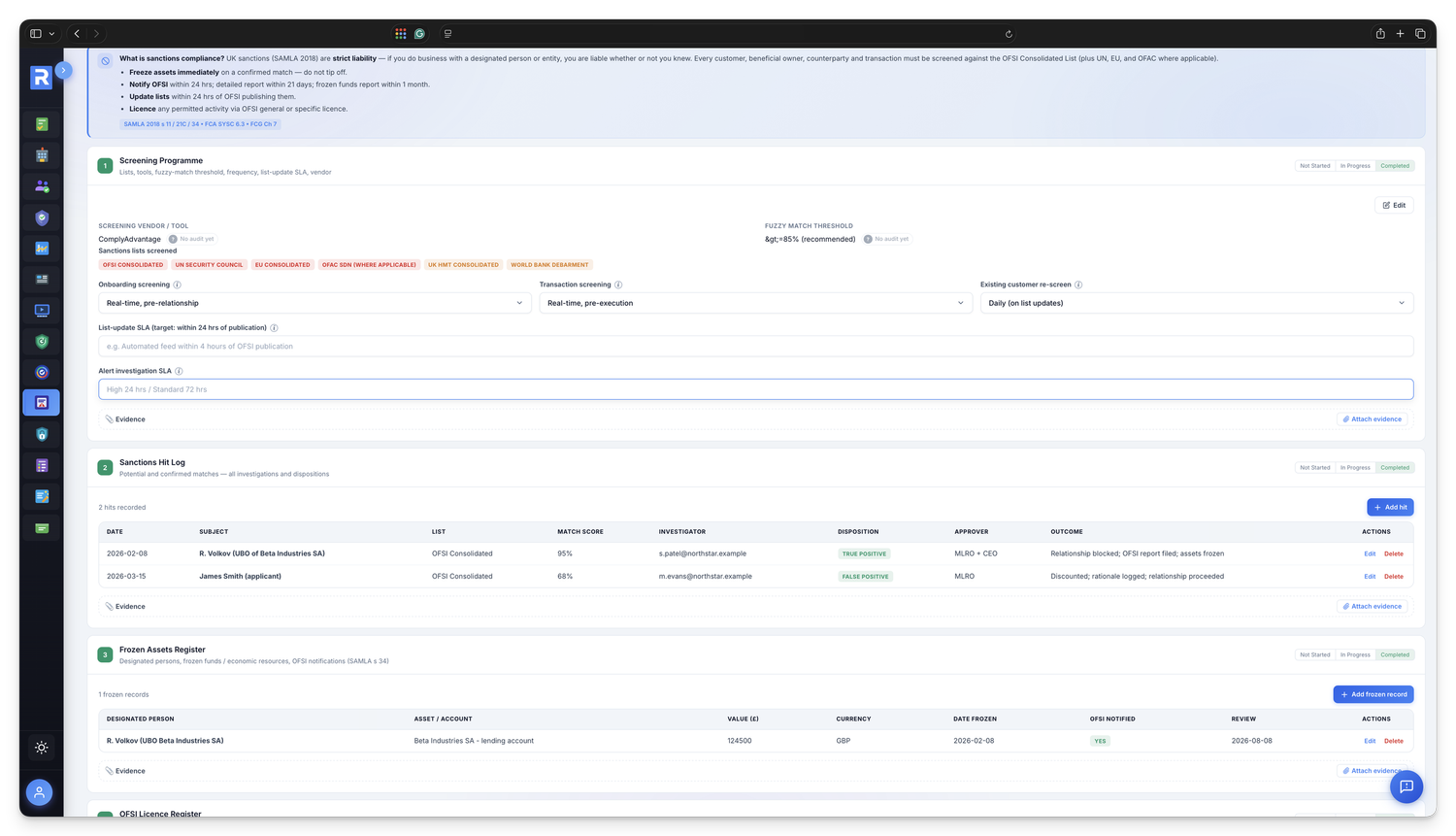
The sanctions workspace: your screening programme — lists, thresholds, cadence — documented in one place, a hit log with dispositions, frozen-assets and OFSI licence registers, and a breach log with the reporting route named from the start.
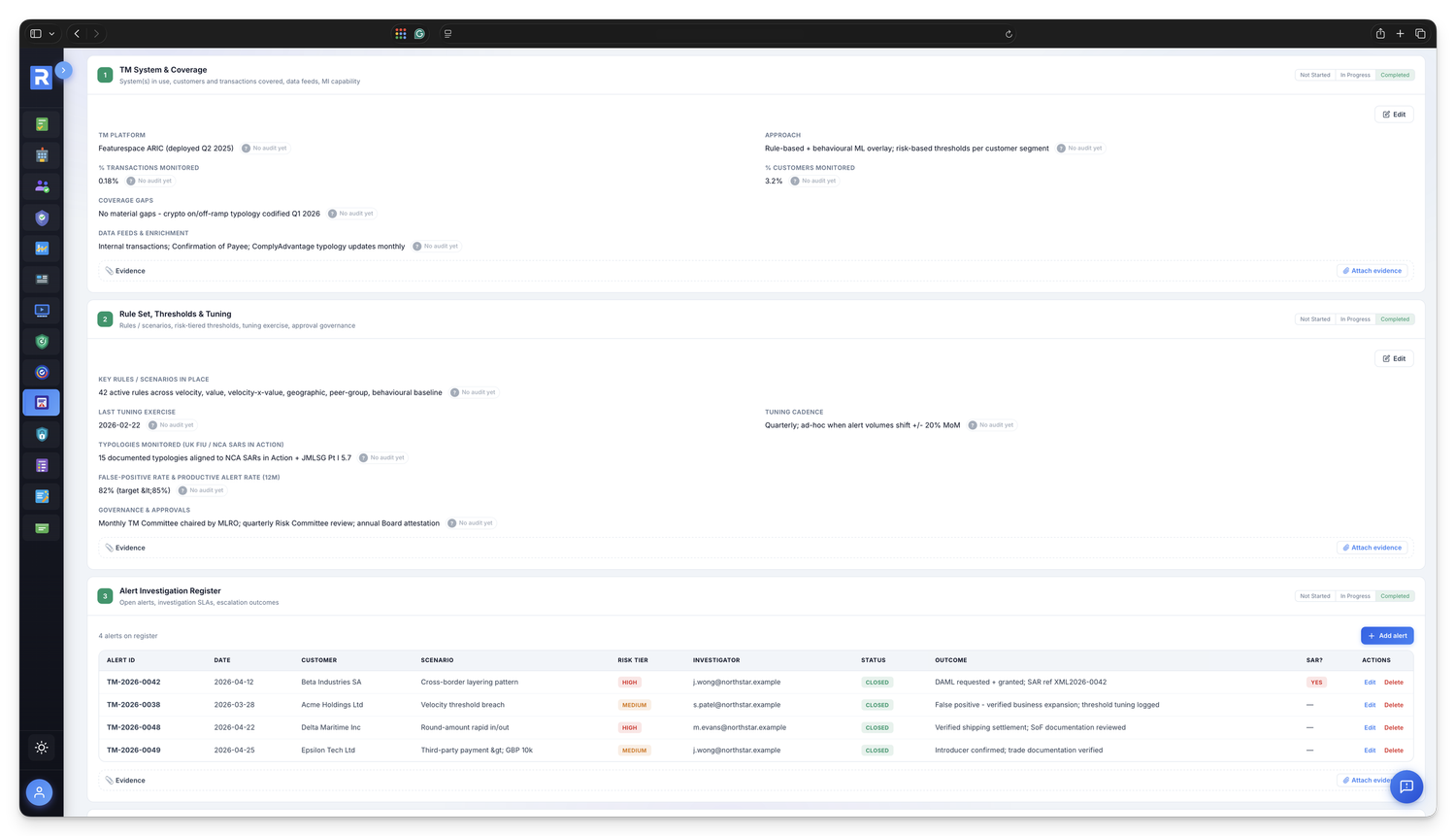
Your transaction-monitoring framework, documented and worked in one place — the monitoring approach on record, alerts logged with their dispositions, and escalation to a SAR traceable end to end.
The module that runs FCA authorisations also runs MLR 2017 registrations — a requirements blueprint scoped to your application, a document checklist, and a lifecycle tracked stage by stage against the statutory clock.
74 regulated activity types plus MLR 2017 registrations — for cryptoasset firms, the four-stage lifecycle simply ends in “Registered” rather than “Authorised”.
Pick the application type and the requirements blueprint is scoped to it — what the gateway expects, mapped before you write a word.
An activity-scoped document checklist with per-item status and upload slots — files attach directly to the checklist row they support.
Submission date, case officer, acknowledgement date and days elapsed against the 180-day assessment window — the sentence your board wants, on demand.
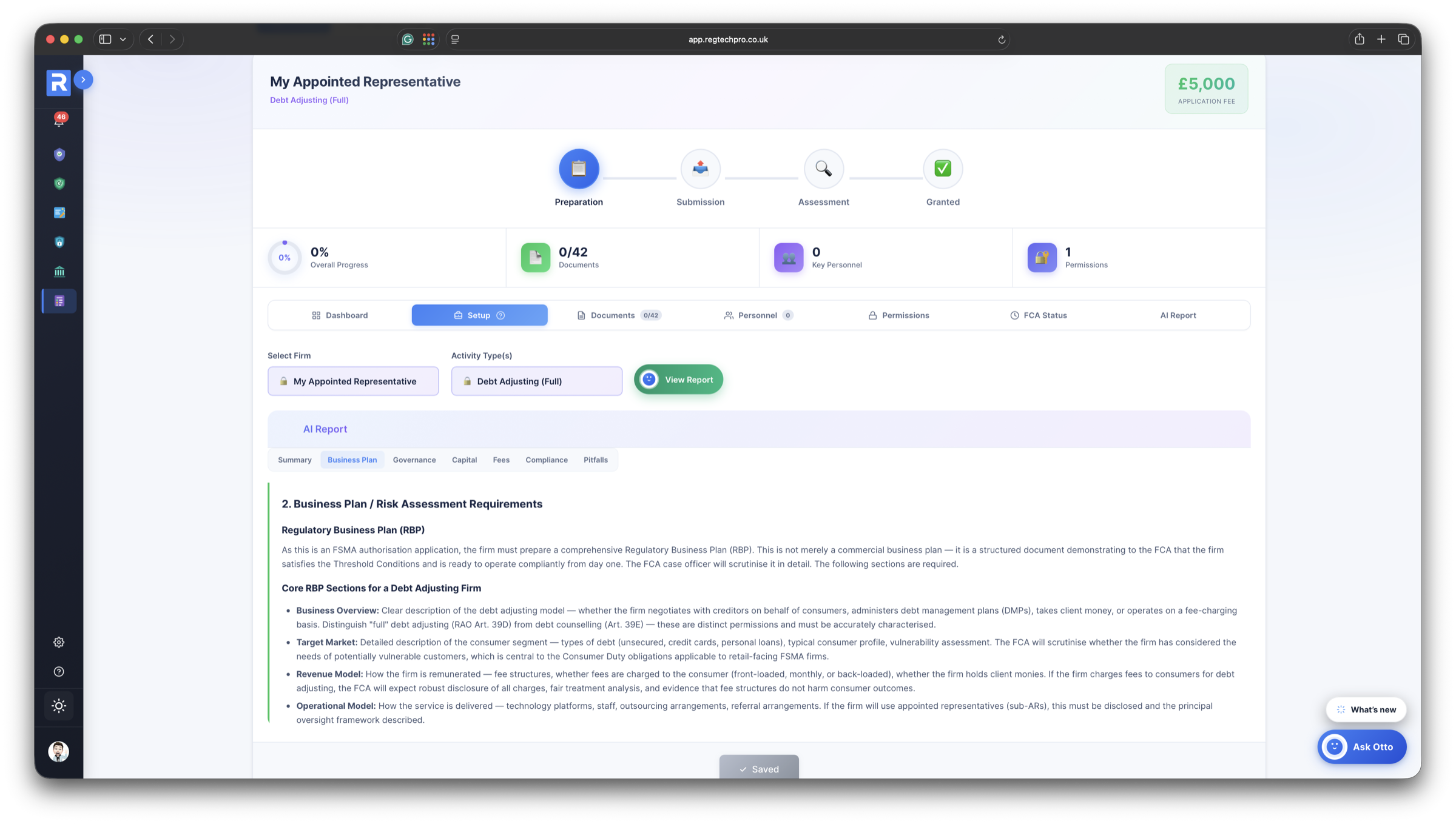
One dashboard for every live application. A 5-tile KPI strip colour-coded by lifecycle stage, and each row showing firm, activity type, stage chip and progress bar. Click a row, see the full application record inline.
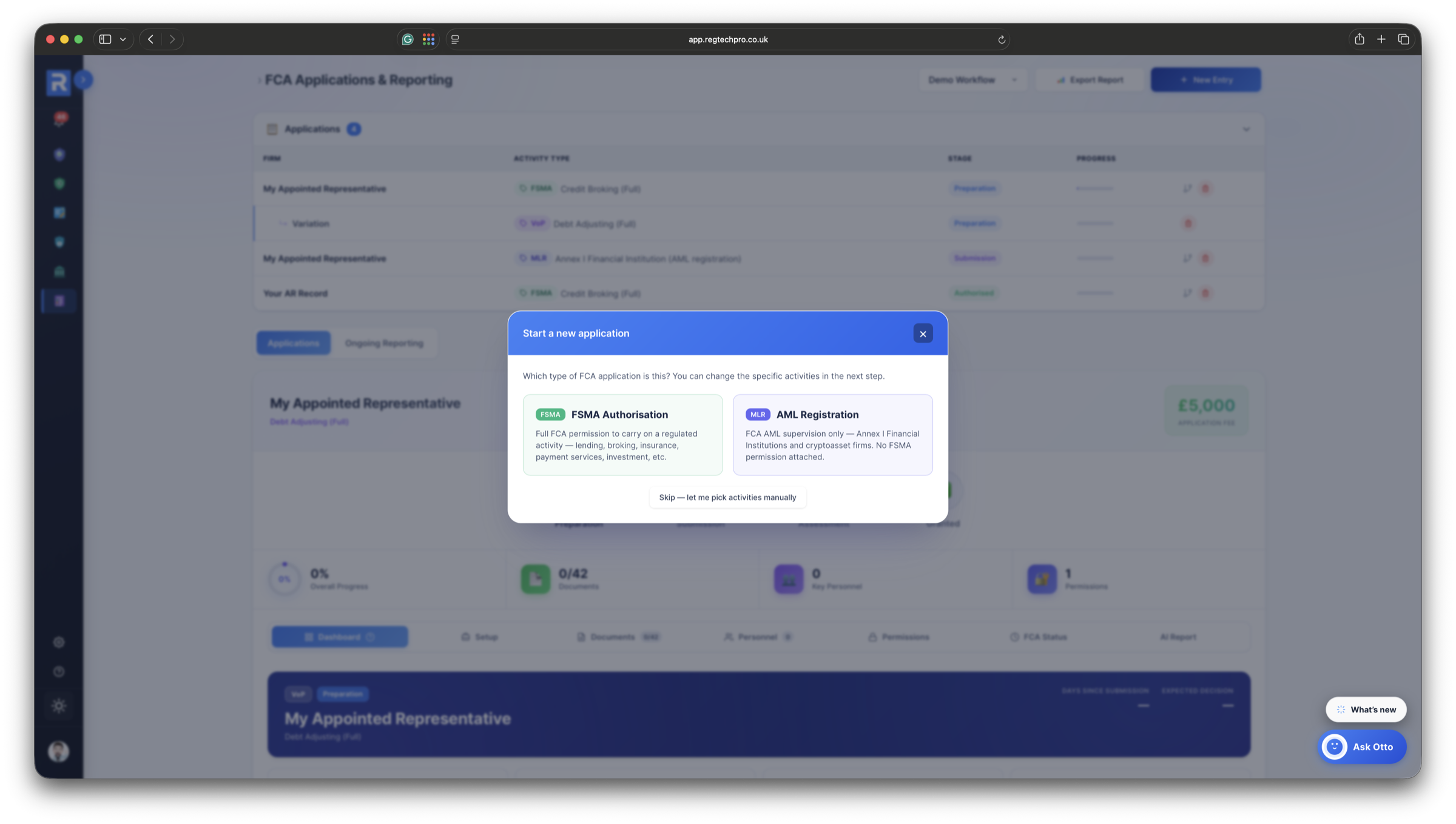
74 regulated activity types plus MLR 2017 registrations — the cryptoasset path built in. Pick the activity your application covers, and the requirements blueprint is scoped to it, not a generic template.
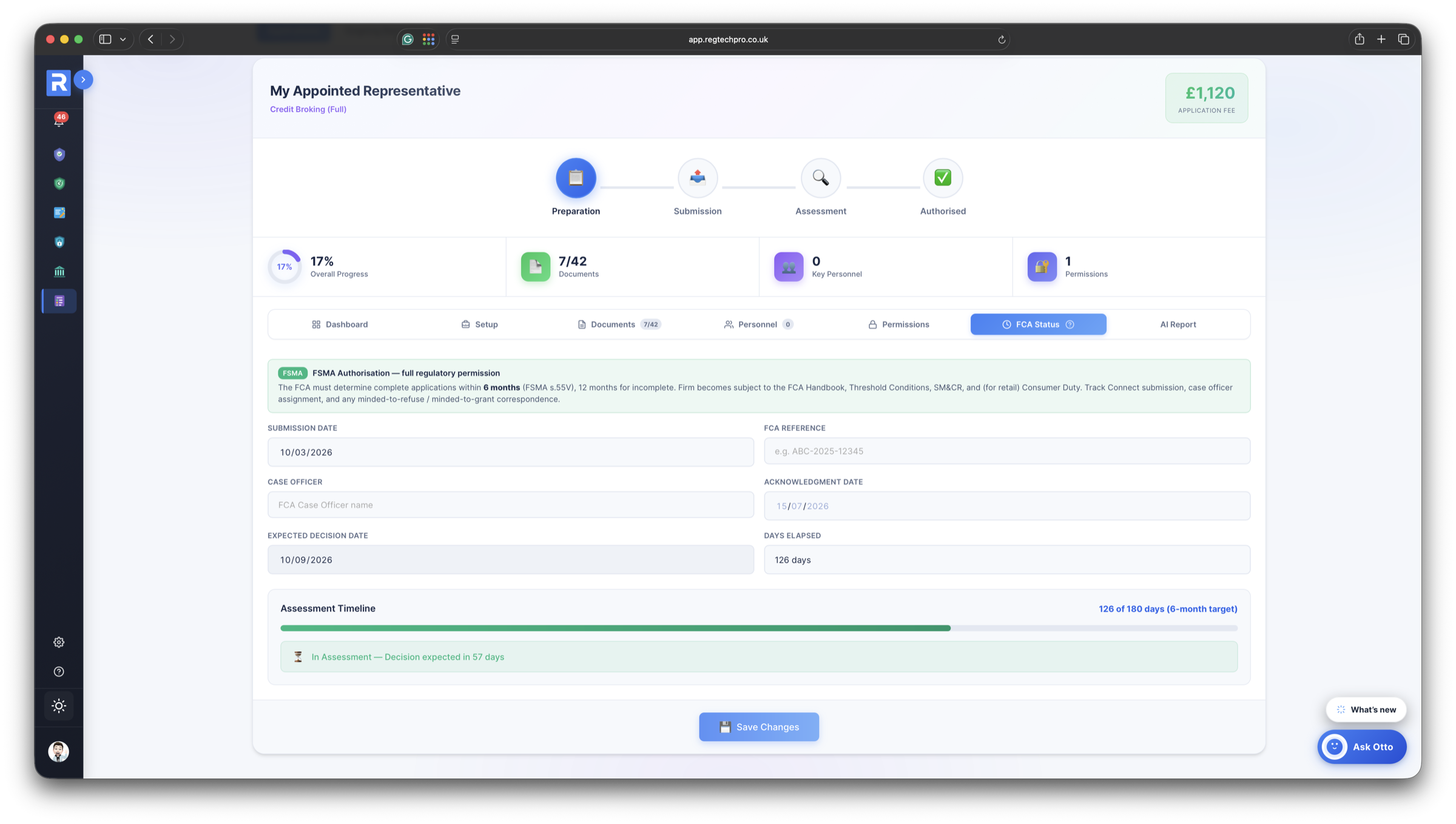
The FCA Status sub-tab. Submission date, case officer, acknowledgement date, expected decision date, days elapsed — all live, with a full-width Assessment Timeline progress bar against the statutory 180-day window.
Otto is the platform’s built-in compliance advisor, grounded in 150+ expert-authored documents. She reads your live monitoring and financial-crime records — not a generic handbook summary — and drafts the reports an MLR-supervised firm has to produce.
The MLRO annual drafted from your live financial-crime records — controls, risk assessment, sanctions and SARs activity — section by section, one of four regulator-grade formats.
A working draft of the annual financial-crime return, assembled from the registers you already keep — not a year-end scramble across spreadsheets.
Registering under MLR 2017? Otto drafts an application requirements report scoped to your activity — what the gateway expects, mapped against what you’ve already built.
Ask about your own AML posture and Otto answers from your live records — which controls are overdue, where the BWRA is thin, what closes the gap.
AI drafts, humans decide — nothing is auto-submitted, and every fact traces to your live firm data.
Three ways to run an MLR-supervised programme. Only one produces evidence the FCA can inspect — on the day they ask for it.
What a founder or MLRO at an MLR-registered cryptoasset business wants to know about platform-grade compliance.
We use essential cookies to make the site work, and optional analytics cookies to understand how it's used. See our Cookie Policy.