
Buy-now-pay-later firms entering FCA regulation run CONC monitoring, financial-promotion approvals, Consumer Duty evidence — and the authorisation itself — from one platform.
14-day free trial · Take the tour
The dedicated E6 CONC chapter
Maker-checker approval built in
A8 chapter + 13-section board report
Firms entering FCA regulation for the first time need a working compliance programme fast. The FCA doesn’t authorise intentions — it authorises firms that can already evidence one.
An authorisation application is assessed on what you can evidence — policies, monitoring, governance, registers. A firm that turns up with a pitch deck and good intentions takes the slowest possible route in.
BNPL promotions run at retail pace — checkout banners, app notifications, social posts. Approvals on email chains can’t keep up, and the regulator will ask who signed each one off, and when.
Whether customers can afford what they’re sold is the FCA’s central concern in consumer credit. When CONC-style creditworthiness standards reach BNPL, the file has to prove each decision — not just record it.
Consumer credit is named in the Duty’s scope, and it applies from the day you’re authorised. A 13-section board report on customer outcomes is a heavy lift for a firm that has never written one.
Complaints, promotions, breaches — recorded in whichever spreadsheet the last hire set up. Registers the FCA can inspect don’t grow out of shared drives.
The BNPL rulebook is landing piece by piece — consultations, policy statements, near-final rules. Miss one and your compliance build is aimed at last quarter’s draft.
BNPL-specific rules are still being finalised — but they are being built on CONC and the Consumer Duty, and both are live on the platform today.
The E6 Consumer Credit — Lending & Broking chapter puts 15 credit-specific checks into your monitoring plan, anchored to CONC 2–8 and 10, the CCA 1974 and the HCSTC price cap — the sourcebook the BNPL regime is being built on. All inside the 1,139-template library.
A register variant built for the CONC regime: every promotion logged, put through maker-checker approval before it runs, and closed with a timestamped audit trail — at the pace BNPL marketing actually moves.
A dedicated CONC attestation form tests your arrangements directly against the Handbook — guided question sets, evidence attached, sign-off recorded. The formal declaration a newly regulated firm can produce, not reconstruct.
Consumer credit is named in the Duty’s scope. The A8 chapter adds Duty checks to your monitoring plan, the module scores the four outcomes and cross-cutting rules, and Otto drafts the 13-section annual board report — affordability and outcomes evidence, ready for the scrutiny BNPL will get.
Regulatory Intelligence carries a dedicated Consumer Credit sector filter, keyword-mapped to CONC and tuned for BNPL and motor finance — so each consultation and policy statement shaping the incoming regime surfaces when it lands, scored for relevance by Otto across the 13-regulator feed.
FCA Applications runs the application itself — 74 regulated activity types scope every requirement, document and fee, with a live tracker against the statutory 180-day window. Start with authorisation, stay for everything else.
The E6 consumer-credit chapter lands in your programme complete — checks, owners, cadences and regulatory references — with the registers and attestations credit firms run alongside.
E6 Consumer Credit — Lending & Broking, anchored to CONC 2–8 and 10, the CCA 1974 and the HCSTC price cap.
74 regulation-anchored categories, including deep-dive chapters on financial promotions (A12) and Consumer Duty (A8).
The financial-promotions register in its CONC variant — maker-checker approval before anything runs, every decision timestamped.
A CONC attestation form with guidance in-form and sign-off recorded — declarations you can produce, not reconstruct.
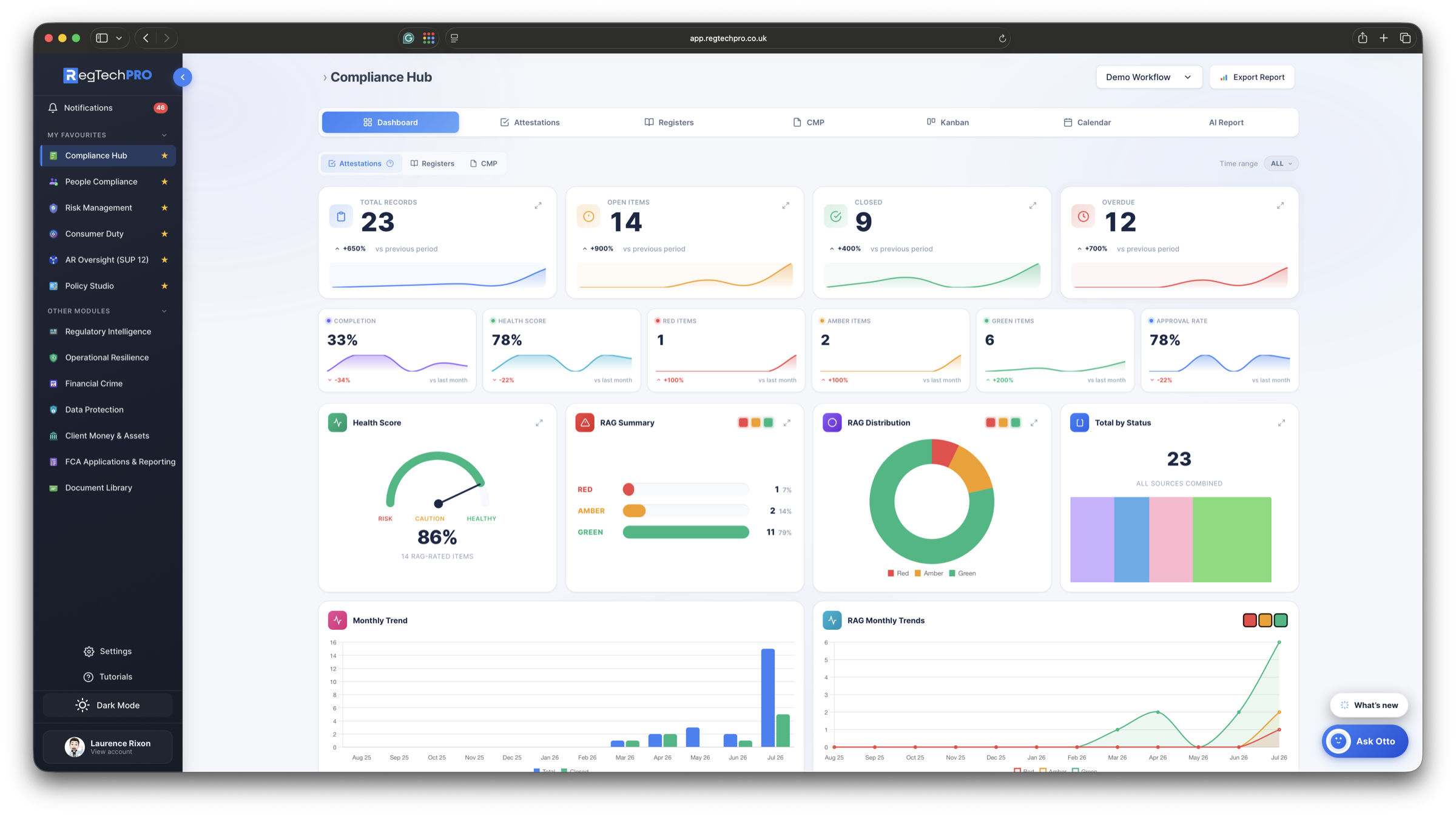
The head-of-compliance landing surface. Live KPI tiles for open, closed and overdue tasks, completion and approval rates, an overall Health Score, RAG summary and monthly trends — every tile a one-click drill-down to the records underneath.
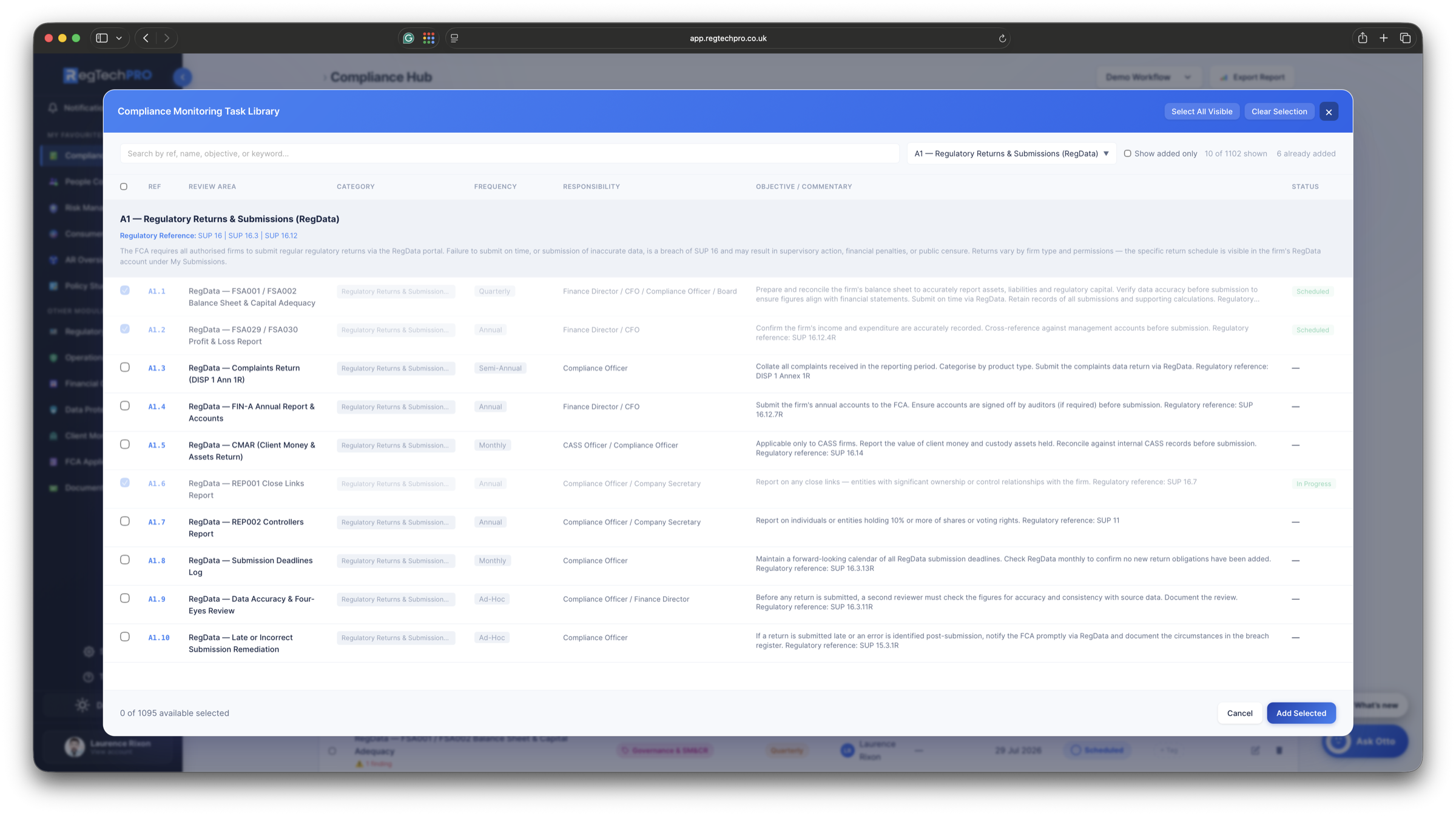
1,139 expert-built monitoring checks across 74 regulation-anchored categories — including the E6 consumer-credit chapter and deep-dive chapters on financial promotions and the Consumer Duty. Each template ships with a regulatory reference chain and plain-English guidance that pre-populates in-form.
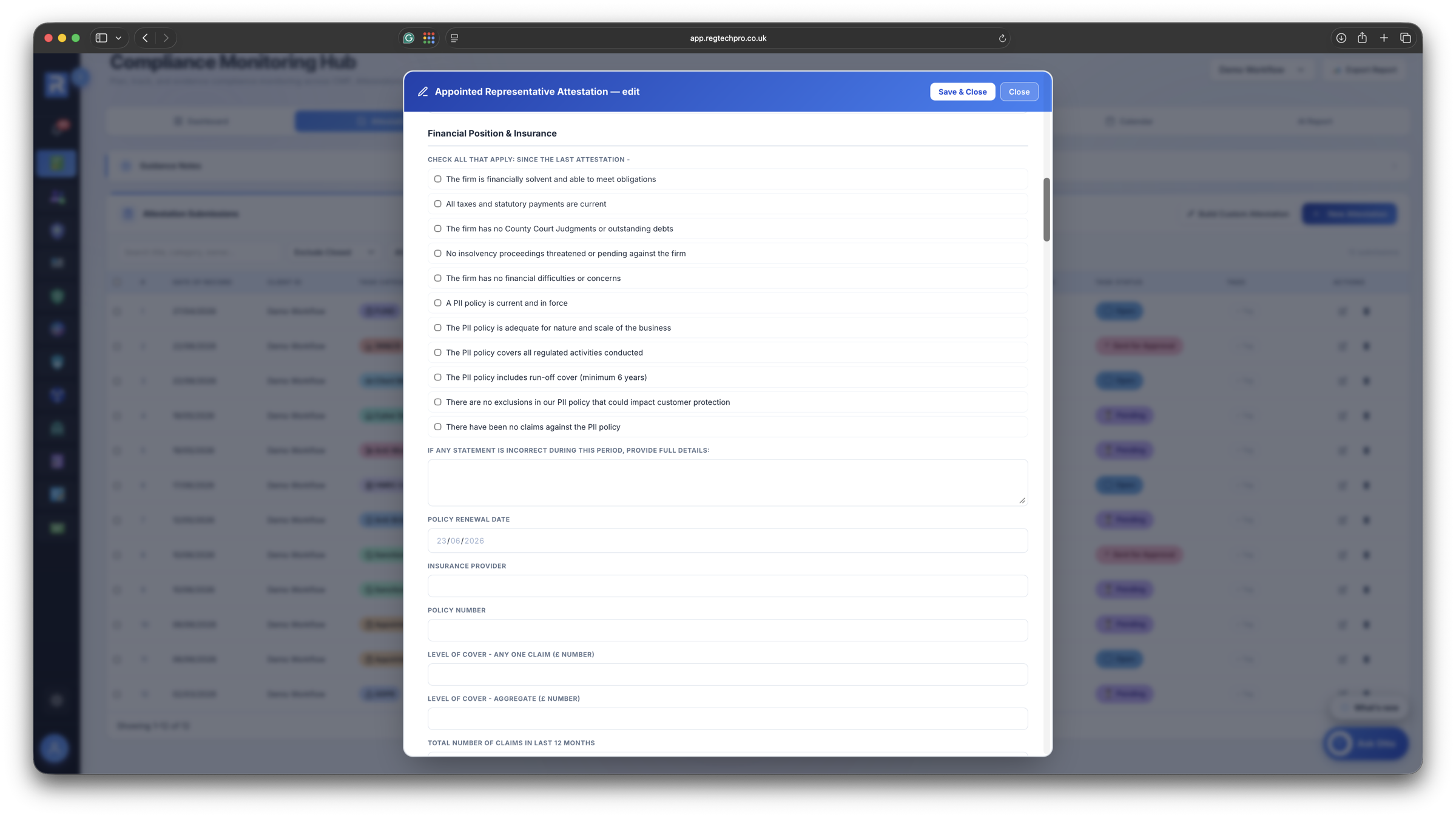
Every formal declaration, completed and signed off in-platform. Attestation forms — CONC among them — with the FCA Principles individually ticked and a maker-checker approval workflow: the form can’t be submitted until every obligation is signed off.
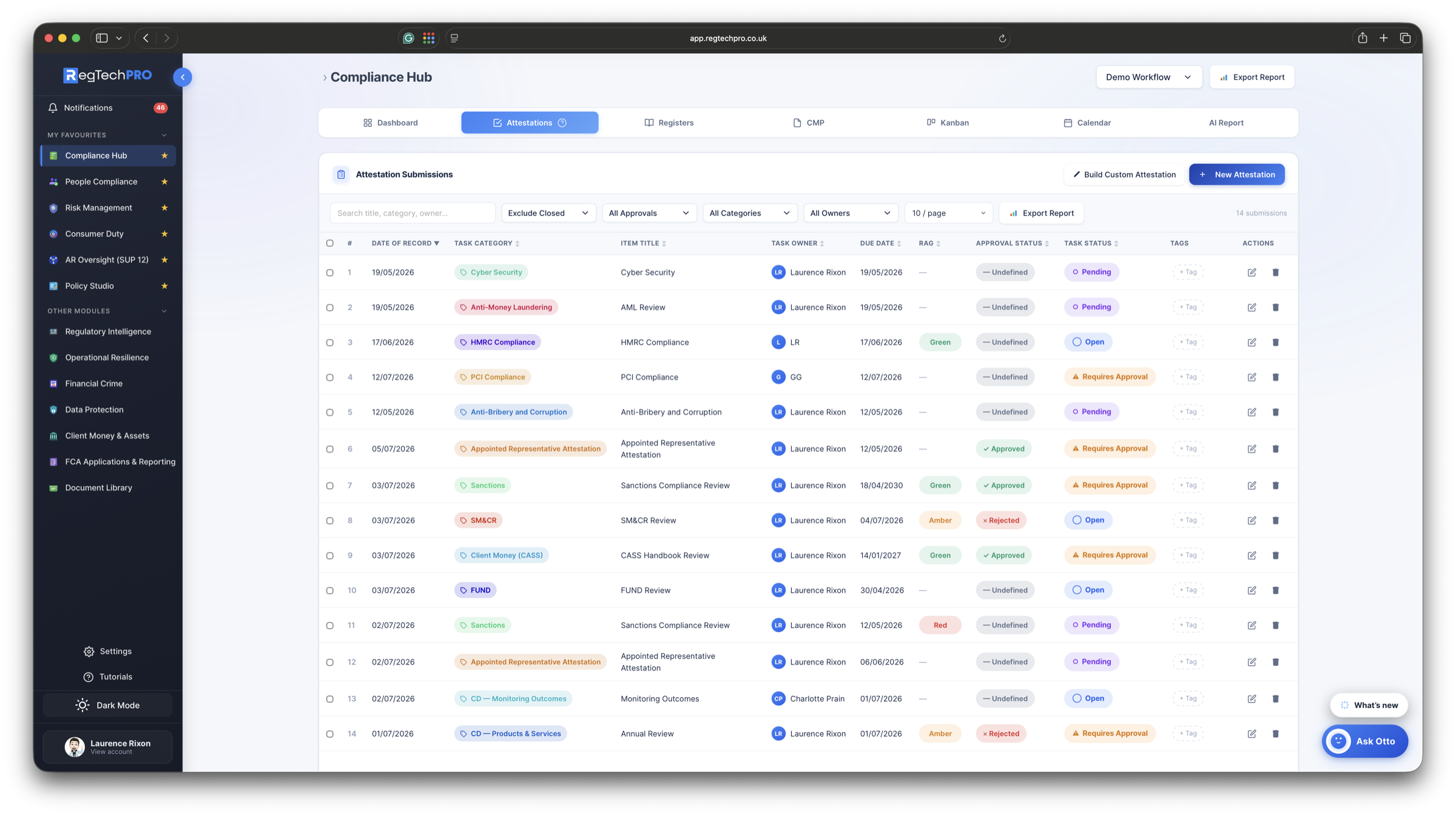
Every event your firm has to record, in one tracker. Financial promotions in their CONC variant, complaints, breaches, gifts & entertainment and conflicts — status chips, named owners, due dates and the same maker-checker approval workflow throughout.
Consumer credit is squarely in the Duty’s scope. Score the four outcomes, run the registers and put a 13-section board report in front of the board — from day one of authorisation.
The full Duty assessment, chapter by chapter — outcomes, cross-cutting rules, governance, foreseeable harm and vulnerable customers — each scored with a named owner.
For a BNPL firm, price & value and products & services are where affordability decisions become outcome evidence the regulator can read.
Complaints, trigger events, adverse outcomes, root-cause analysis, vulnerability and the gap register — each linked to named owners and attached evidence.
Otto drafts the PRIN 2A annual board report from your live data — executive summary, health score, sign-off and challenge record.
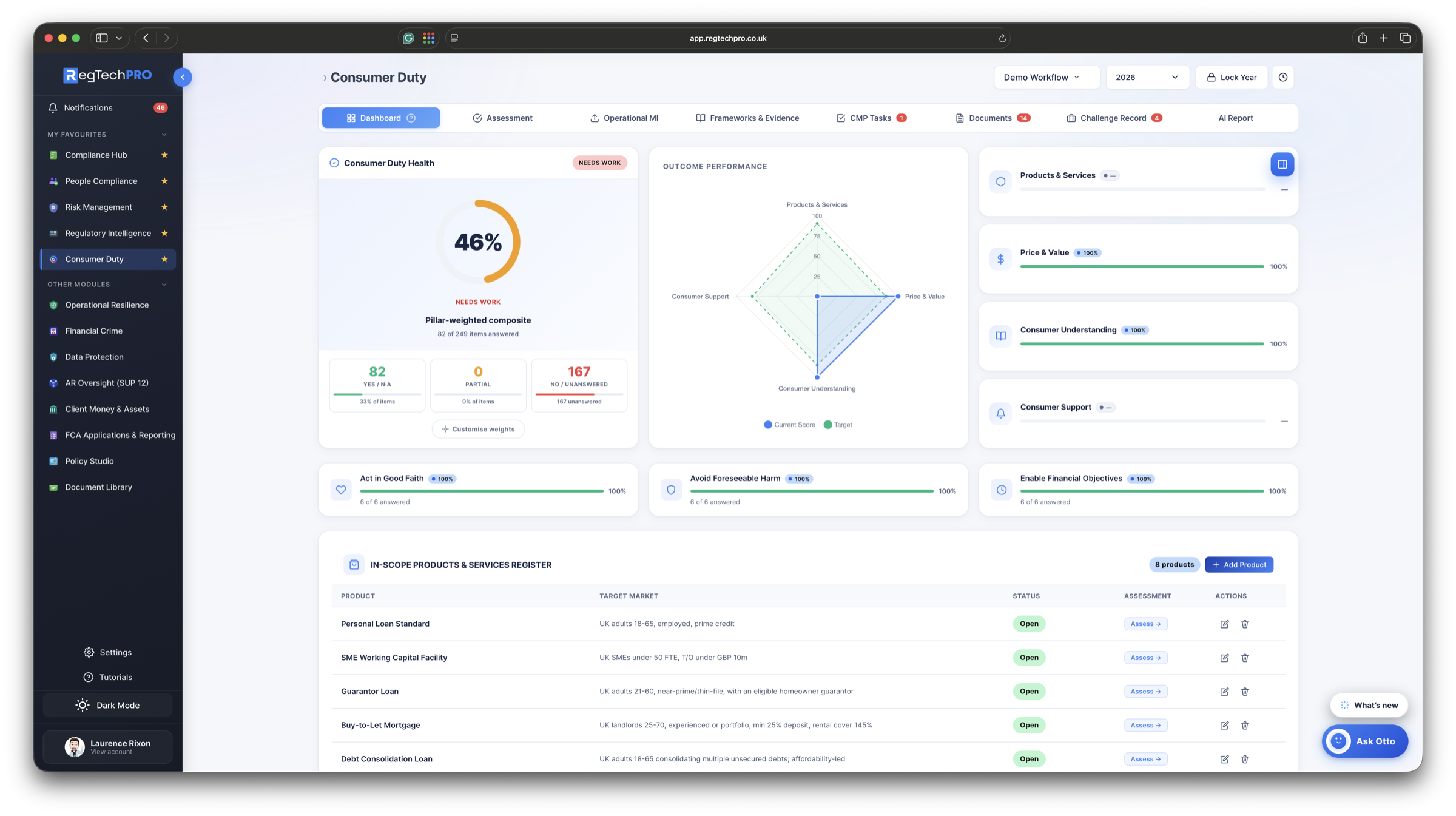
A 30-second status check for the whole firm: a Consumer Duty Health donut, the four-outcome performance radar against your own thresholds, the cross-cutting rules, the in-scope products & services register and quarter-on-quarter trend — every PRIN 2A obligation, one screen.
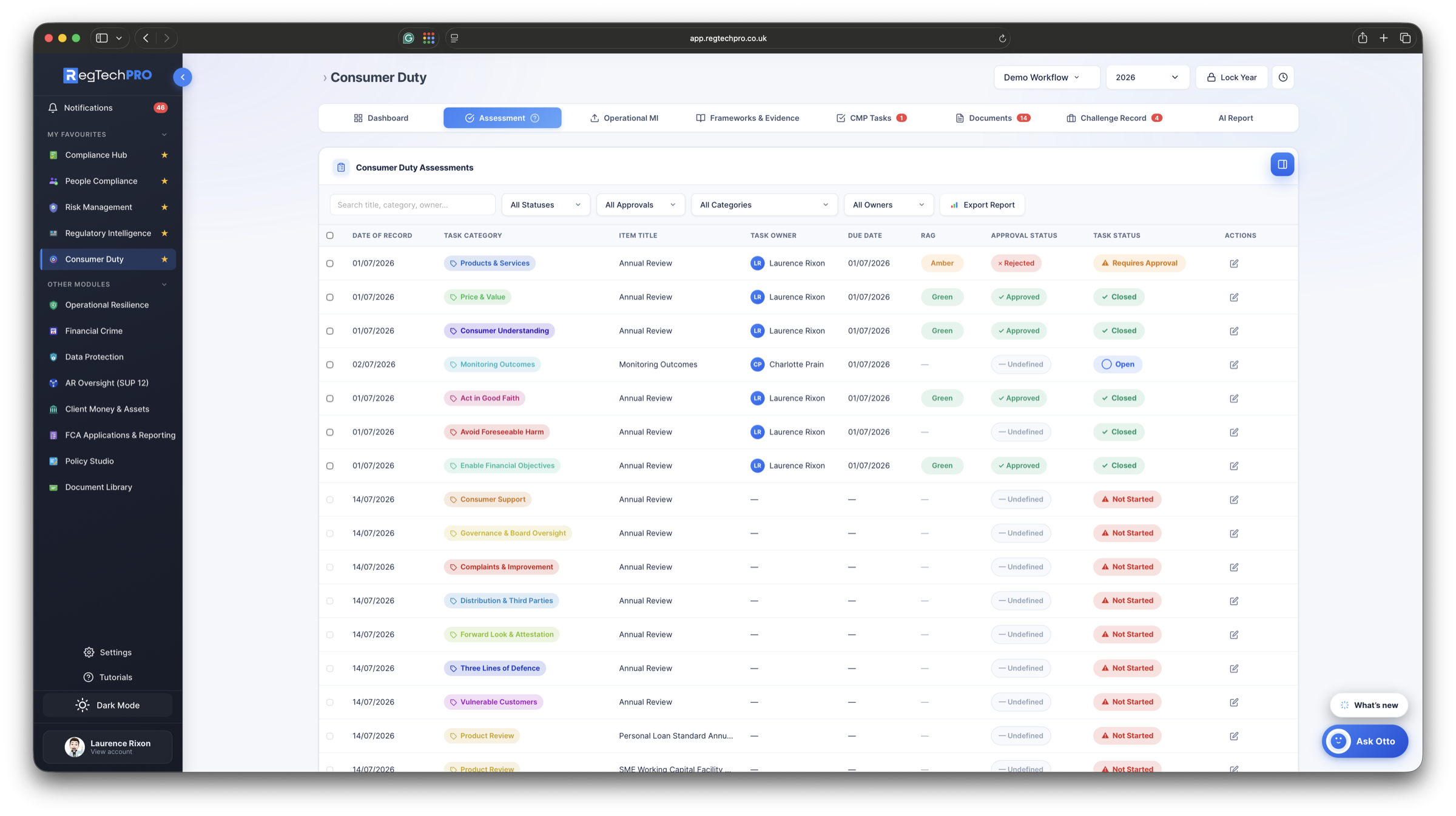
The full Consumer Duty assessment, chapter by chapter: the four outcomes, the cross-cutting rules and the wider areas — governance, monitoring, complaints, foreseeable harm and vulnerable customers — each scored against FCA expectations with a named owner and evidence. For a BNPL firm, this is where affordability meets the Duty.
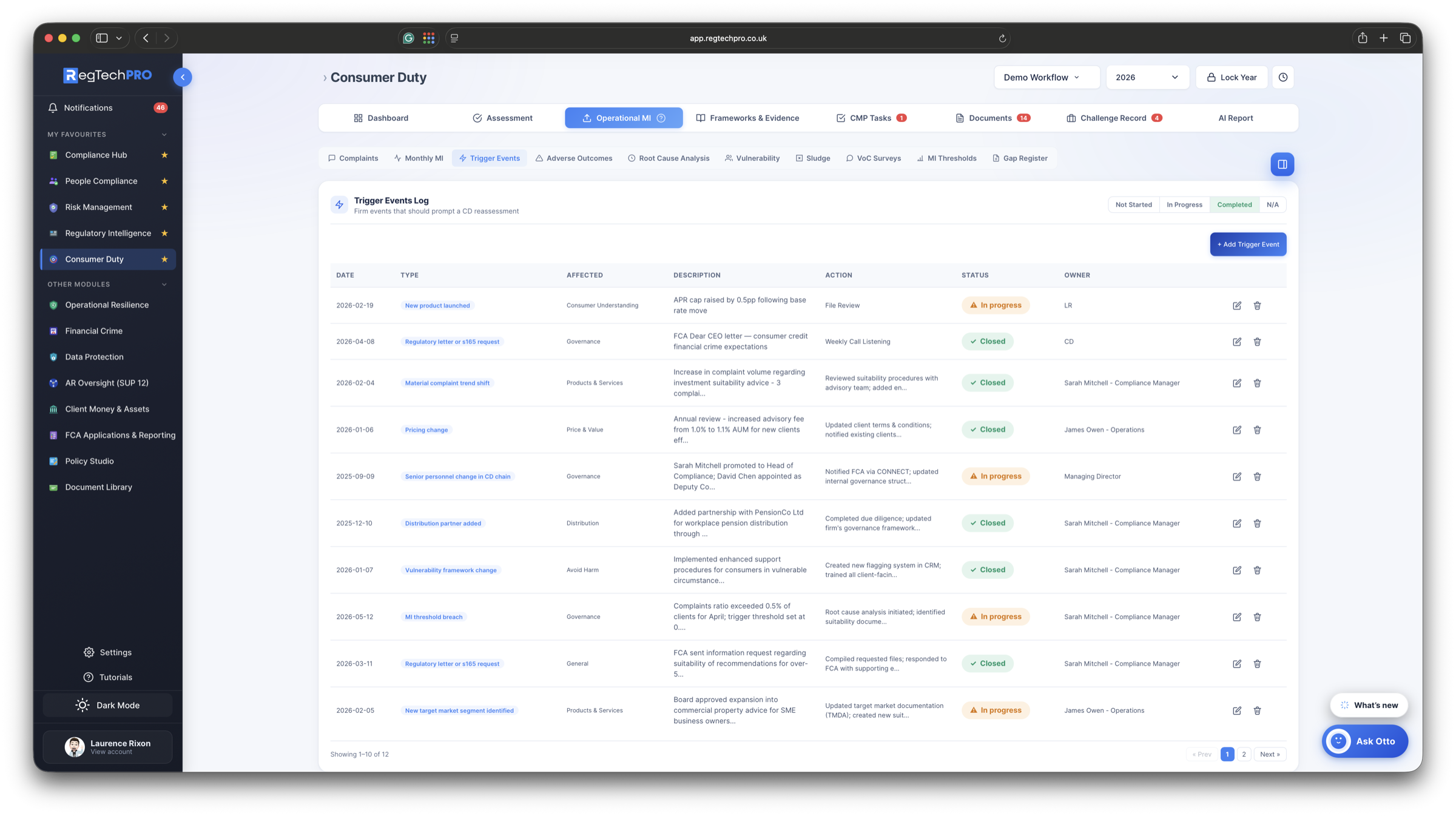
Every Consumer Duty register in one place: Complaints, Monthly MI, Trigger Events, Adverse Outcomes, Root Cause Analysis, Vulnerability, KPI Thresholds and the Gap Register — each linked to named owners and attached evidence, year-on-year traceable.
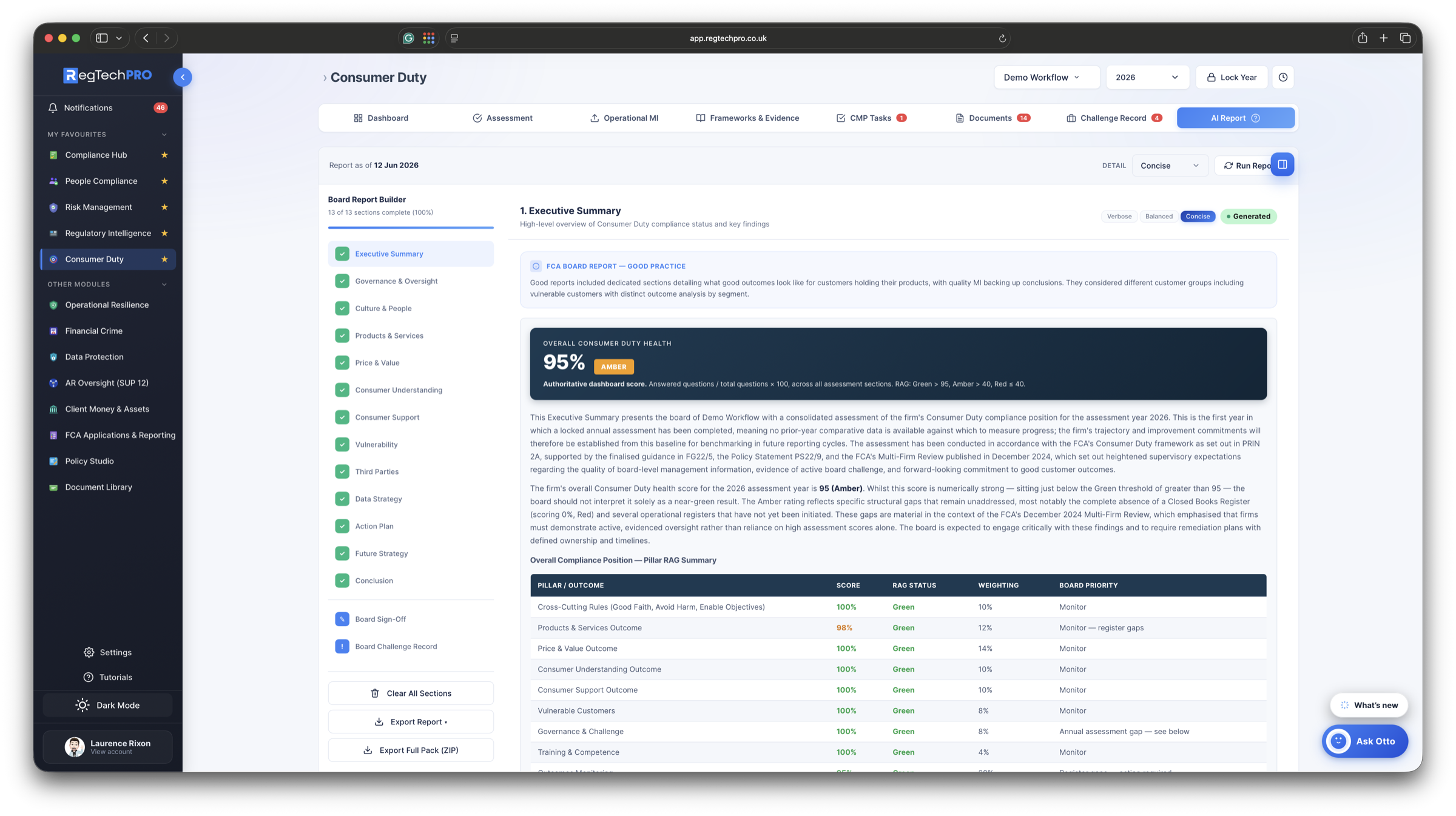
The 29-page PRIN 2A Annual Board Report drafted by Otto from your live data in seconds. An executive summary and an overall Consumer Duty health score, 13 sections plus Sign-Off and Challenge Record. Review, sign, export — board-ready, supervisor-ready.
Firms coming into regulation for the first time run the authorisation itself on the platform — scoped requirements, tracked documents and a live view of the statutory 180-day window.
Pick the permission you’re applying for and the module scopes every downstream requirement, document and fee — not a generic checklist.
Every supporting document tracked to Received with the evidence attached — nothing missing on the day you submit through FCA Connect.
Submission date, case officer, acknowledgement and expected decision — a live progress bar against the statutory clock.
The moment you’re authorised, the same platform is your monitoring plan, registers and Consumer Duty evidence — no second implementation.
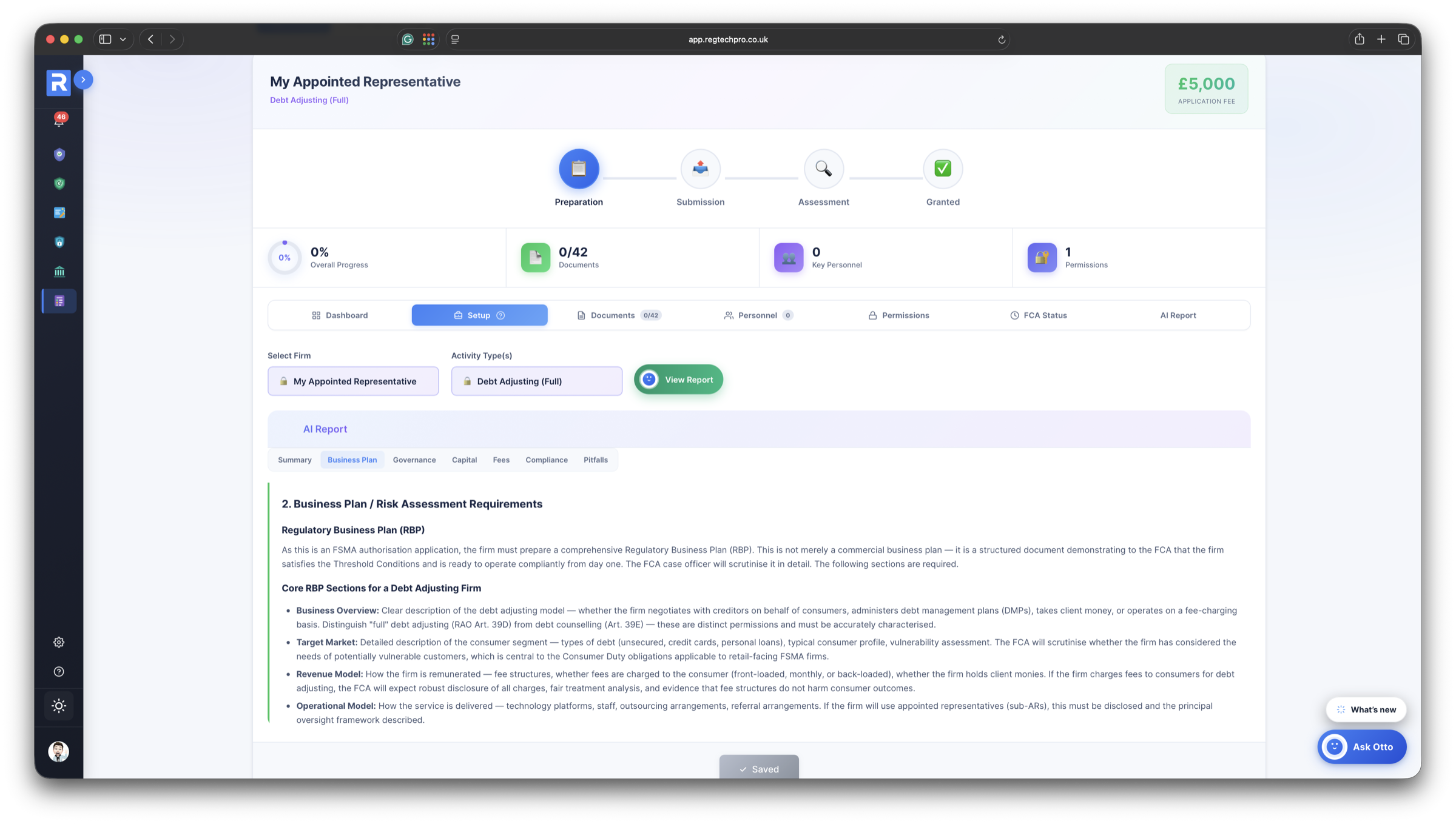
One dashboard for every live application. A five-tile KPI strip across Total, Preparation, Submission, Assessment and Authorised, colour-coded by lifecycle stage — each row shows the activity type, stage chip and progress bar, and clicking it opens the full application record.
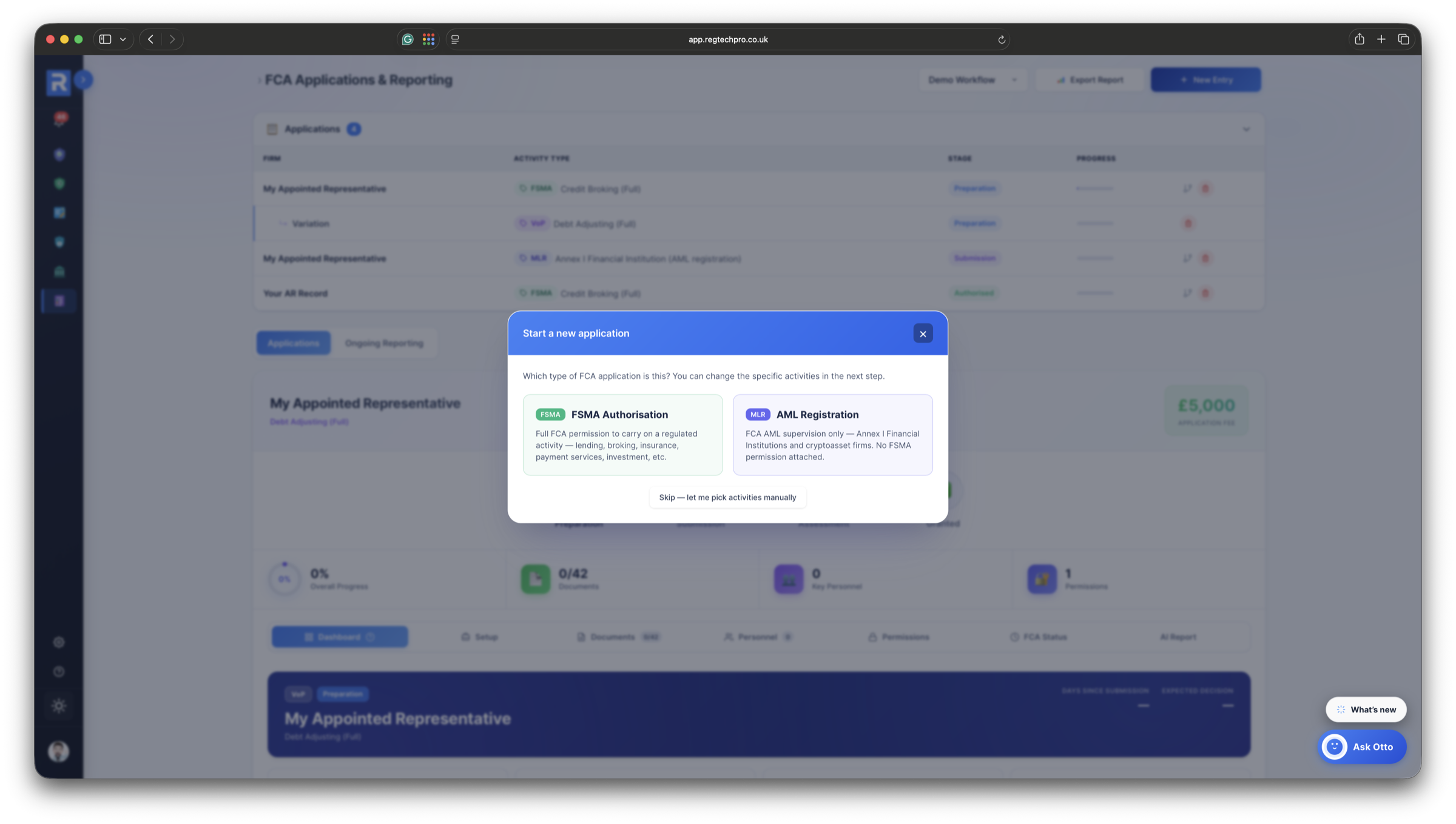
The starting point: pick from 74 FCA regulated activity types, and the module scopes every downstream requirement, document and fee to the permission you’re actually applying for — not a generic checklist.
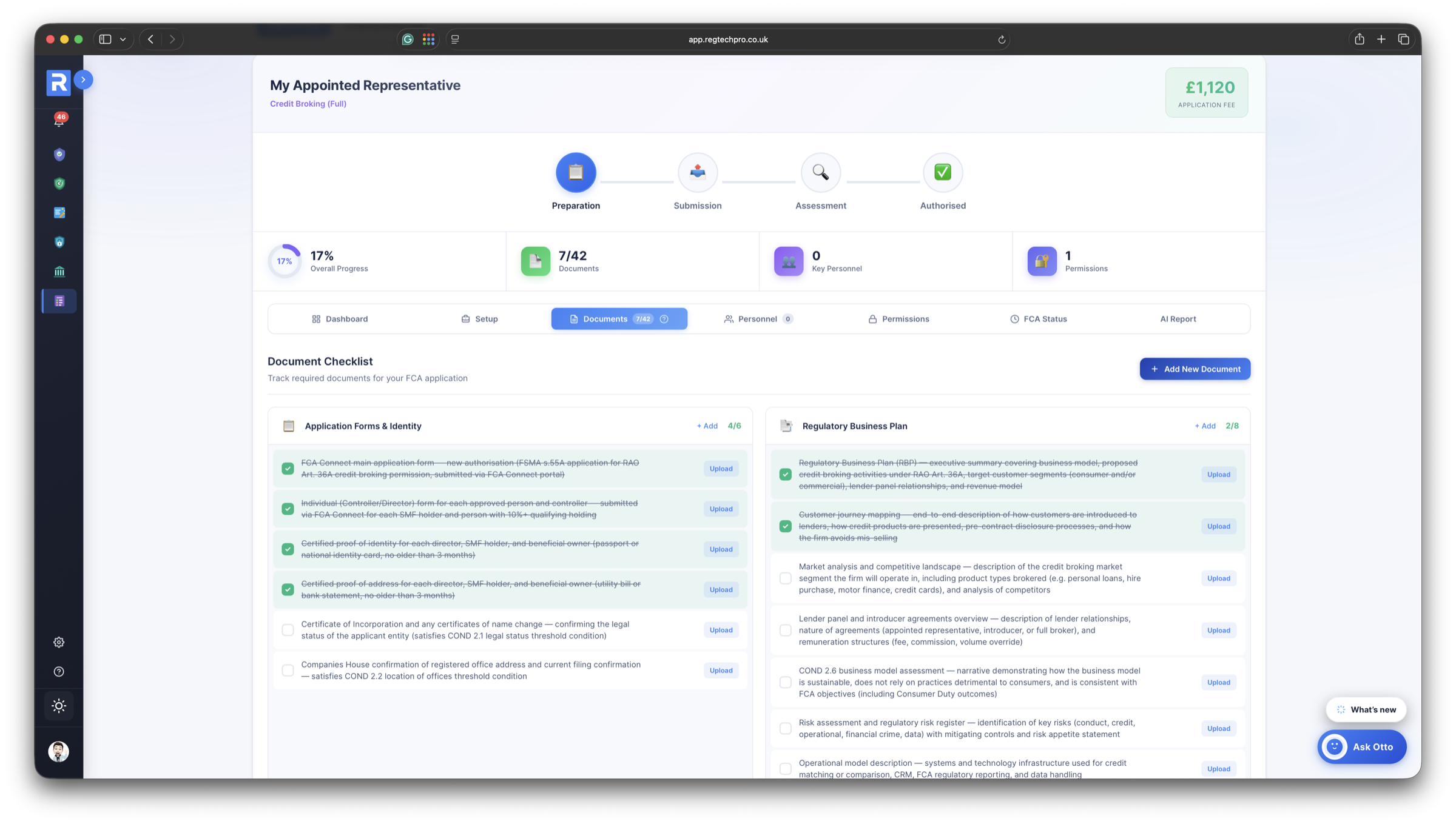
The checklist your case officer will effectively mark you against. Every supporting document scoped to your activity type and tracked to Received with the evidence attached — so nothing is missing on the day you submit through FCA Connect.
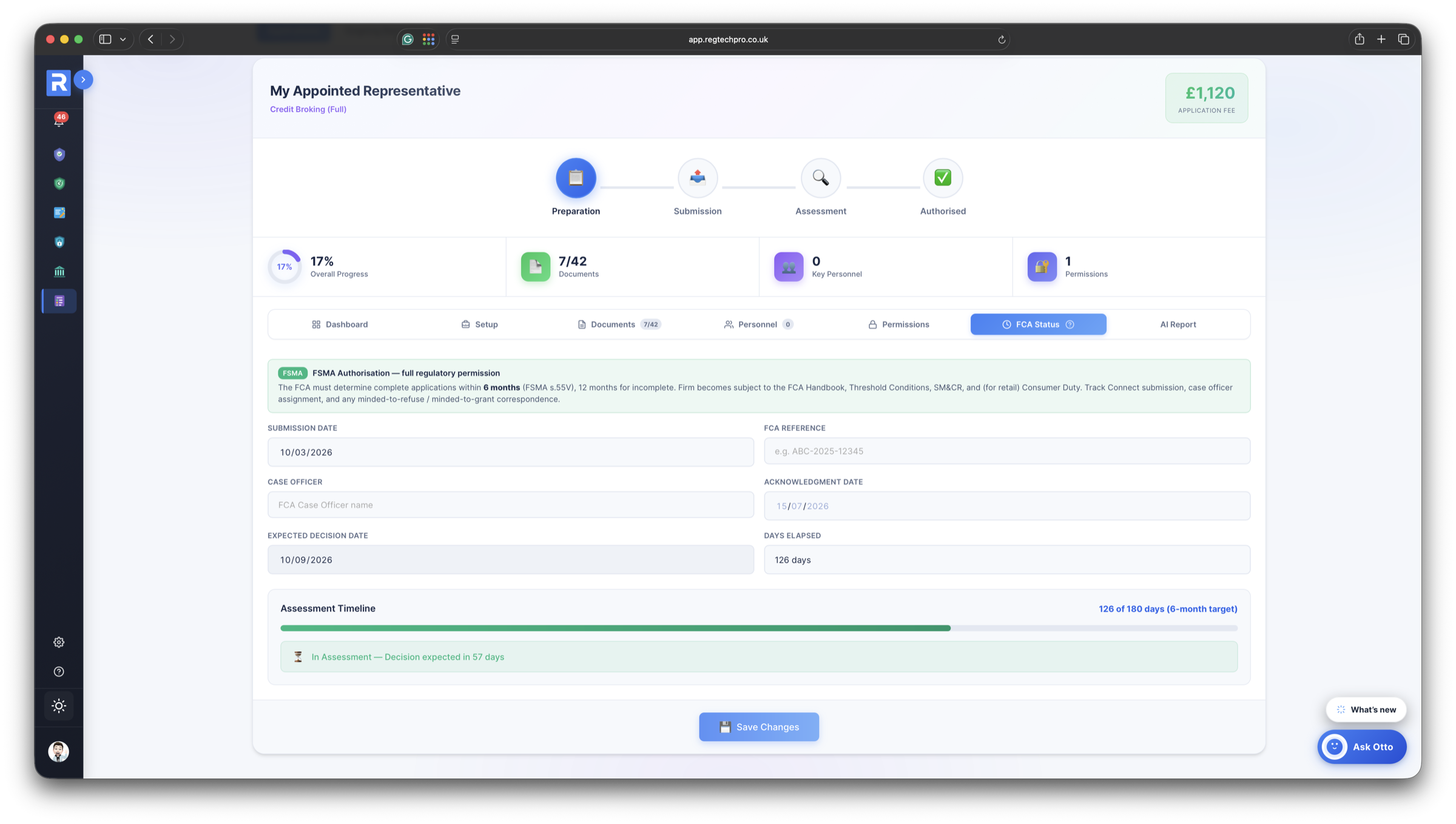
The FCA Status view once you’ve submitted: submission date, case officer, acknowledgement date and expected decision date, all live, with a full-width progress bar against the statutory 180-day window. The sentence your board wants: “We’re 73 days in, decision expected in 107.”
Otto is the platform’s built-in compliance advisor, grounded in 150+ expert-authored documents. She reads your live monitoring, Consumer Duty and register data — not a generic handbook summary — and drafts the reports a newly regulated credit firm is expected to produce.
Your year’s monitoring drafted from live data, citing CONC among its 13 regulatory anchors — coverage, findings and remediation, section by section.
The 13-section PRIN 2A annual board report drafted from your live outcome data — with sign-off and challenge record built in.
The MLRO annual drafted from your live financial-crime records — fraud controls alongside AML and sanctions, the exposure lenders actually carry.
Ask about your own readiness and Otto answers from your live records — which checks are overdue, where the evidence is thin, what closes the gap before the regulator asks.
AI drafts, humans decide — nothing is auto-submitted, and every fact traces to your live firm data.
Three ways to build a compliance programme for the new regime. Only one produces evidence the FCA can inspect — from the day you're authorised.
What a BNPL founder or a newly appointed head of compliance wants to know about entering FCA regulation.
We use essential cookies to make the site work, and optional analytics cookies to understand how it's used. See our Cookie Policy.