
P2P and investment-based crowdfunding platforms run appropriateness, financial promotions, Consumer Duty and investor-onboarding controls from one platform — with the evidence trail the FCA expects.
14-day free trial · Take the tour
E11 dedicated CMP chapter
A8 chapter + 13-section board report
P2P + IFISA keywords, 13 regulators
Crowdfunding platforms sit where COBS meets CONC, marketing high-risk investments to retail customers — the FCA doesn’t ask whether you complied. It asks you to prove it.
COBS 4.7 prescribes how high-risk investments are marketed to retail investors. If your evidence of which warning appeared, where and when is a screenshot folder, it won’t survive scrutiny.
Each listing, banner and investor email sits under s21 FSMA and COBS 4. When the FCA asks how promotions are checked before they run — and by whom — the trail has to exist.
Retail investors must be assessed before they invest. If the record of who was tested, when and against what lives only in your product database, compliance can’t produce it on demand.
Retail investors put your platform squarely in the Duty’s scope. When the board asks for outcomes evidence across all four outcomes, assembling it from spreadsheets takes weeks.
Investors on one side, fundraisers on the other — both need documented KYC, risk ratings and review cadences. Onboarding records scattered across tools are a finding waiting to happen.
Crowdfunding rules have moved repeatedly, and policy statements land weekly across 13 UK regulators. Missing the one that rewrites your marketing restrictions is how platforms fall behind.
A dedicated E11 chapter, a named sector filter and the Consumer Duty evidence retail-investor platforms are judged on.
E11 Crowdfunding & P2P puts 15 sector-specific checks into your monitoring plan — the direct-offer and risk-warning rules under COBS 14.4 and 4.7, the CONC provisions that bite P2P lending, and client-money anchors under CASS 7 and 10 where the platform holds investor funds. Part of the 1,139-template library.
The A-chapter backbone carries the controls investment-based platforms run continuously: A11 Suitability & Appropriateness tests how retail investors are assessed before they invest, and A12 Financial Promotions monitors every promotion against COBS 4 and s21 FSMA — each around 15 checks, with owners, cadences and evidence attached.
Retail investors put crowdfunding platforms squarely in the Duty’s scope. The Consumer Duty module runs structured assessments across all four outcomes and drafts the 13-section board report from your live data — with the A8 chapter adding Duty checks to your monitoring plan.
Regulatory Intelligence carries a dedicated Crowdfunding sector filter, keyword-mapped to P2P and IFISA — and Otto scores each item’s relevance to your firm across the 13-regulator feed, so the consultation that rewrites your marketing rules surfaces at the top.
The Financial Crime module documents CDD and KYC across both sides of your marketplace — investors and fundraisers risk-rated and reviewed on cadence, sanctions screening with a hit log, and the records the MLRO’s annual report is built on.
The E11 Crowdfunding & P2P chapter lands in your programme complete — checks, owners, cadences and regulatory references — with the appropriateness and fin-prom chapters platforms run alongside.
E11 Crowdfunding & P2P — anchored to COBS 14.4 and 4.7, CONC 1.2 and 5A, with CASS 7 and 10 anchors where investor money is held.
74 regulation-anchored categories, including deep-dives on suitability and appropriateness (A11) and financial promotions (A12).
Financial promotions monitored through the E11 and A12 chapters — scheduled checks against COBS 4 and s21 FSMA, with owners and evidence attached.
Complaints, breaches, gifts & entertainment and conflicts as structured registers — every entry closed through a maker-checker approval, timestamped.
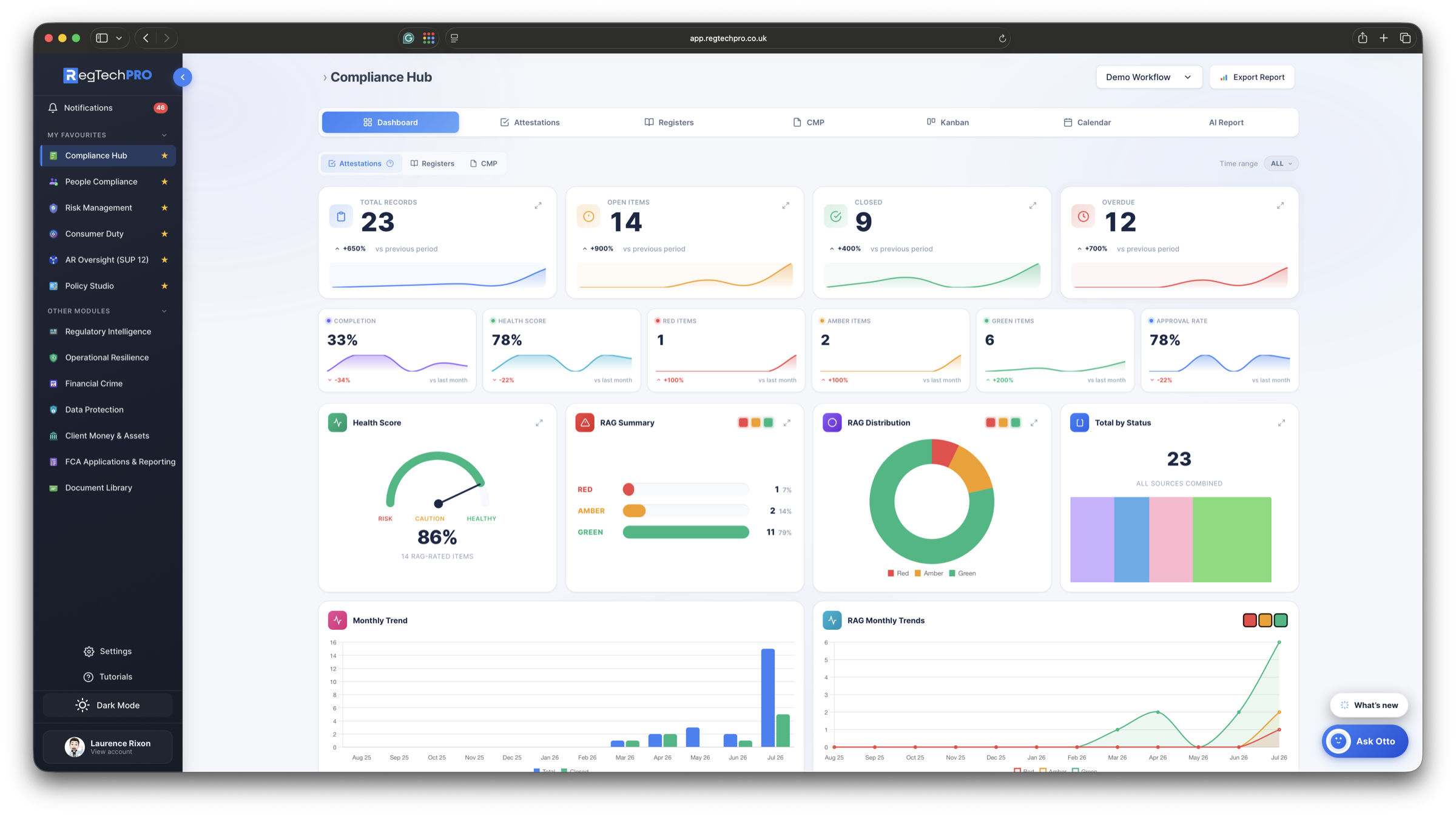
The head-of-compliance landing surface. Live KPI tiles for open, closed and overdue tasks, completion and approval rates, an overall Health Score, RAG summary and monthly trends — every tile a one-click drill-down to the records underneath.
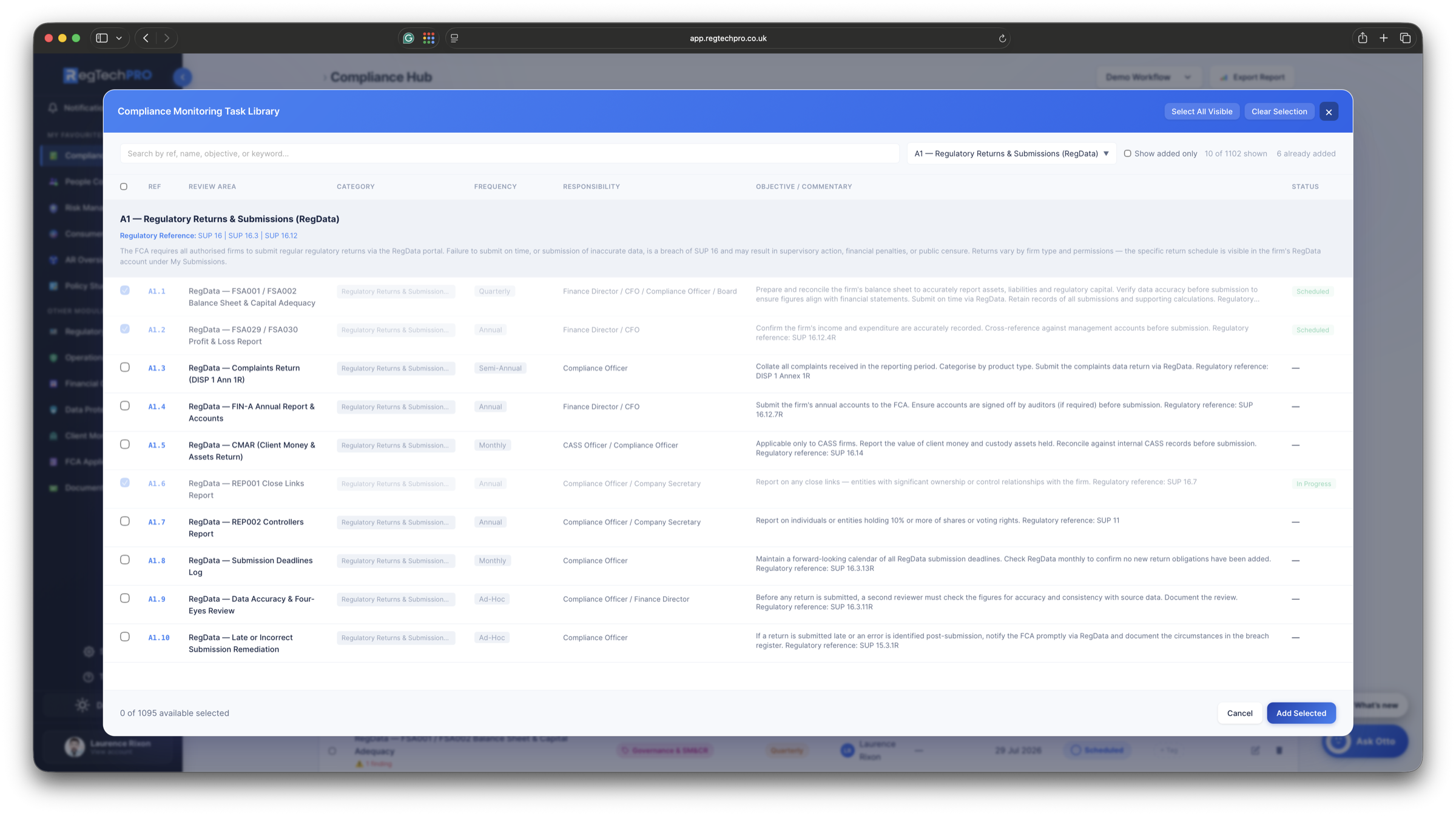
1,139 expert-built monitoring checks across 74 regulation-anchored categories — including the E11 Crowdfunding & P2P chapter and deep-dive chapters on suitability, appropriateness and financial promotions. Each template ships with a regulatory reference chain and plain-English guidance that pre-populates in-form.
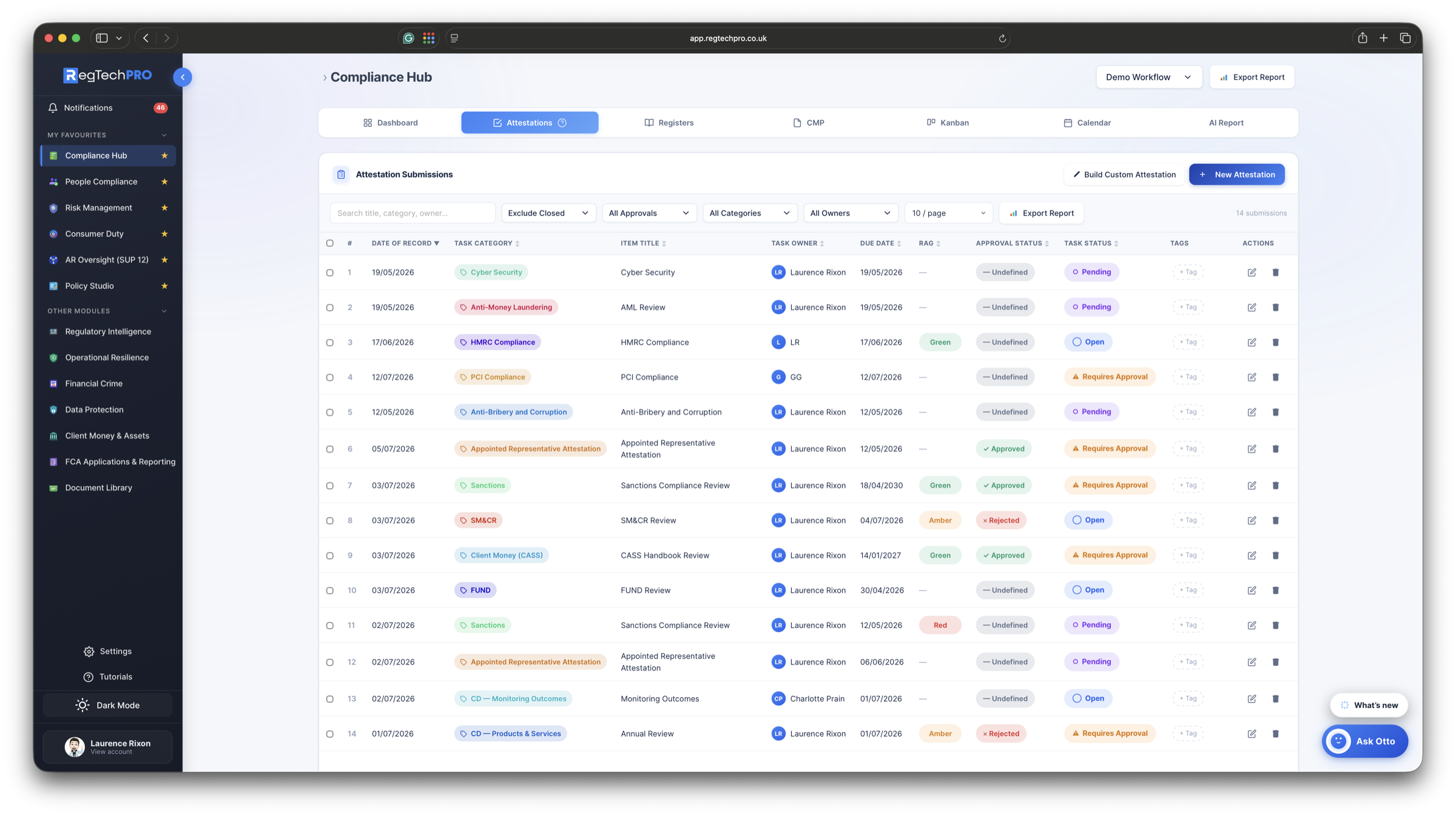
Every event your platform has to record, in one tracker. Complaints, breaches, gifts & entertainment and conflicts — status chips, named owners, due dates and a maker-checker approval workflow throughout.
Crowdfunding and P2P platforms serve retail customers directly, so good outcomes have to be assessed, monitored and reported to the board — the module does all three from live data.
Products and services, price and value, consumer understanding and consumer support — structured assessments per product, with gaps flagged.
The annual Consumer Duty board report drafted from your live assessment data — not rebuilt from spreadsheets every year-end.
Registers and management information for retail-investor outcomes, kept current between board cycles — evidence, not assertion.
Consumer Duty monitoring checks sit inside your compliance monitoring plan alongside E11 — one programme, one evidence trail.
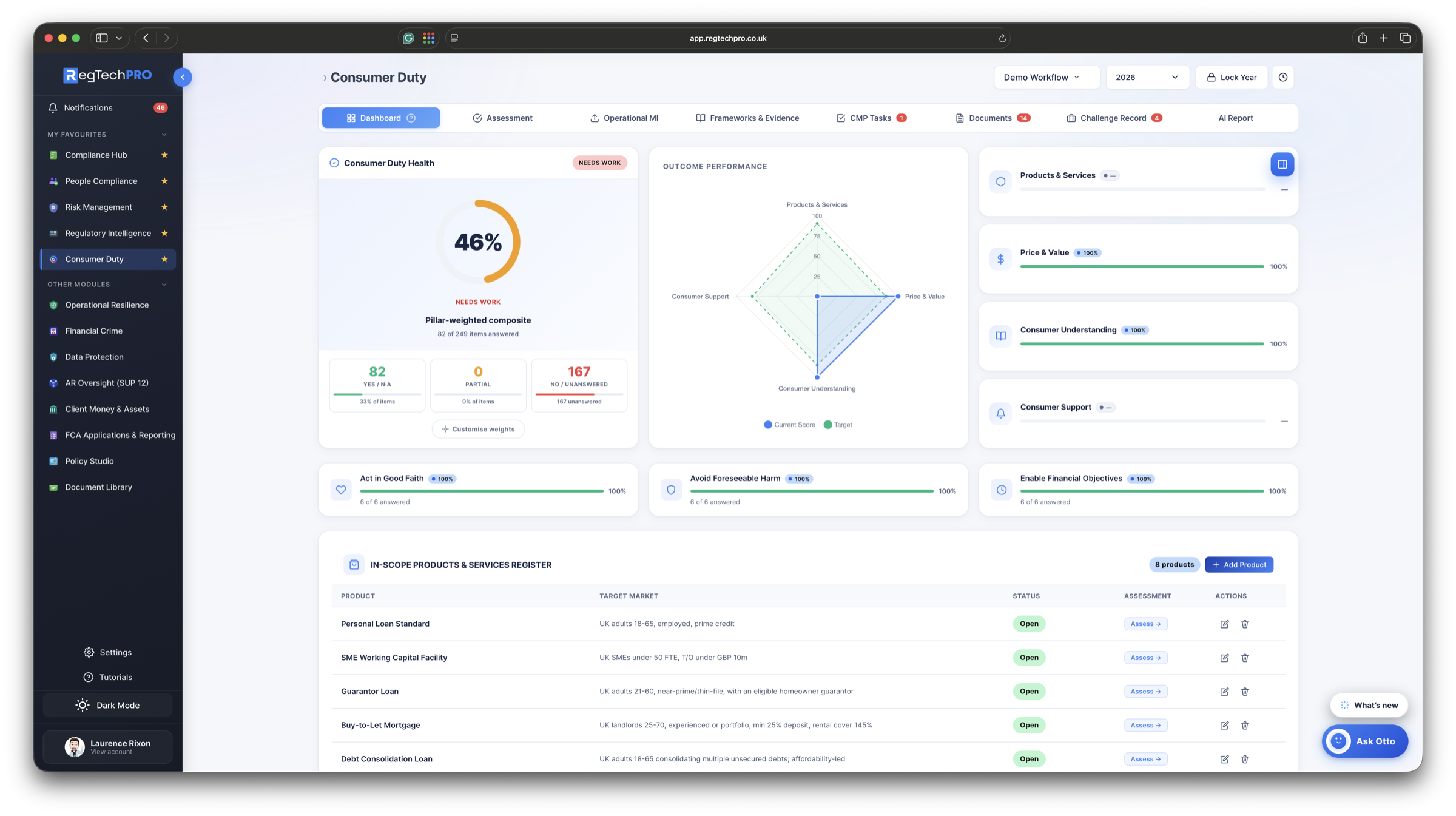
Your Duty position on one screen — outcome-by-outcome scores, assessment progress and where the evidence is thin. For a platform serving retail investors, this is the page the board asks to see.
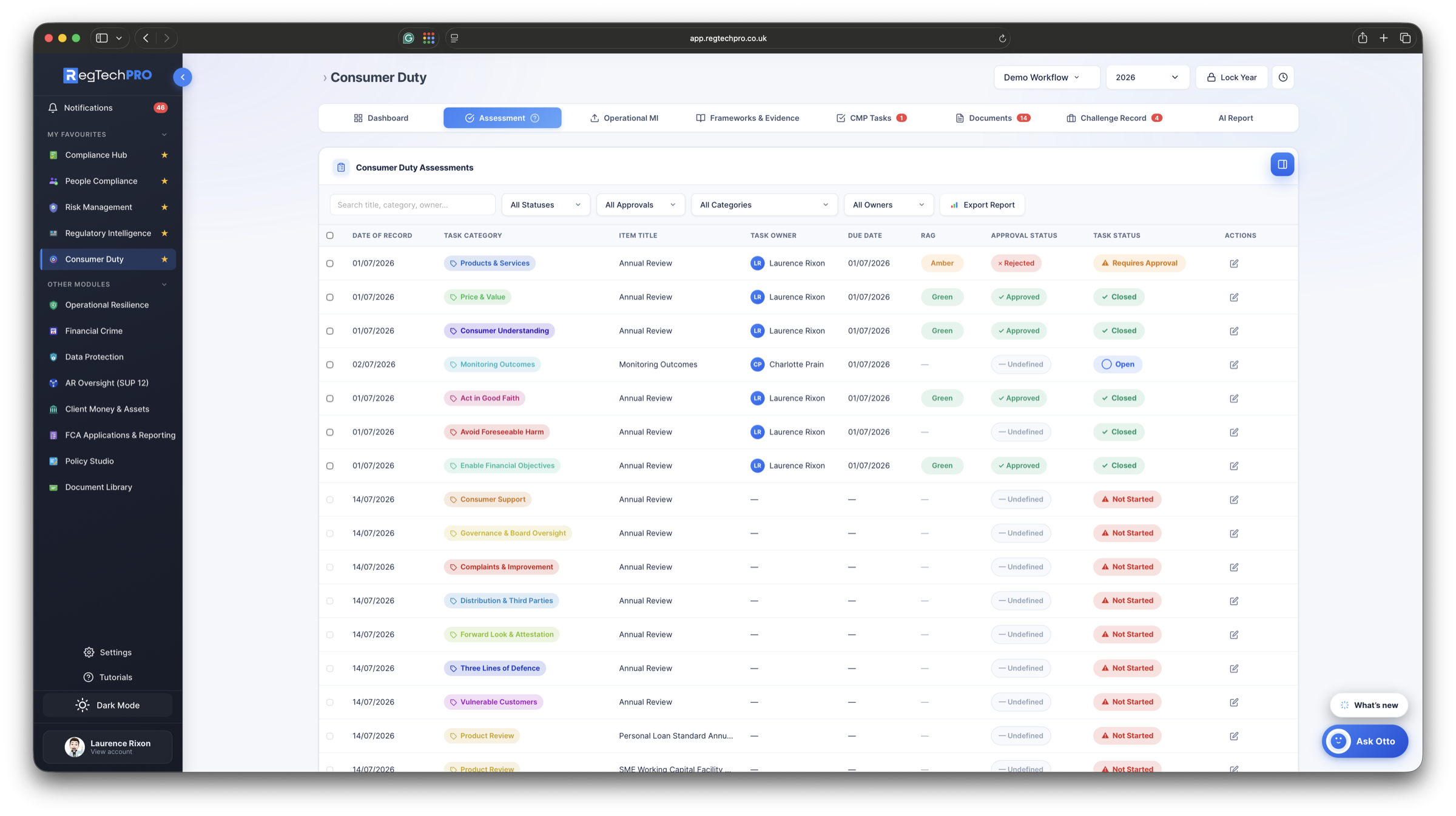
Structured assessments across the four outcomes — guided question sets applied to each product or service on your platform, with findings, owners and remediation recorded as you go.
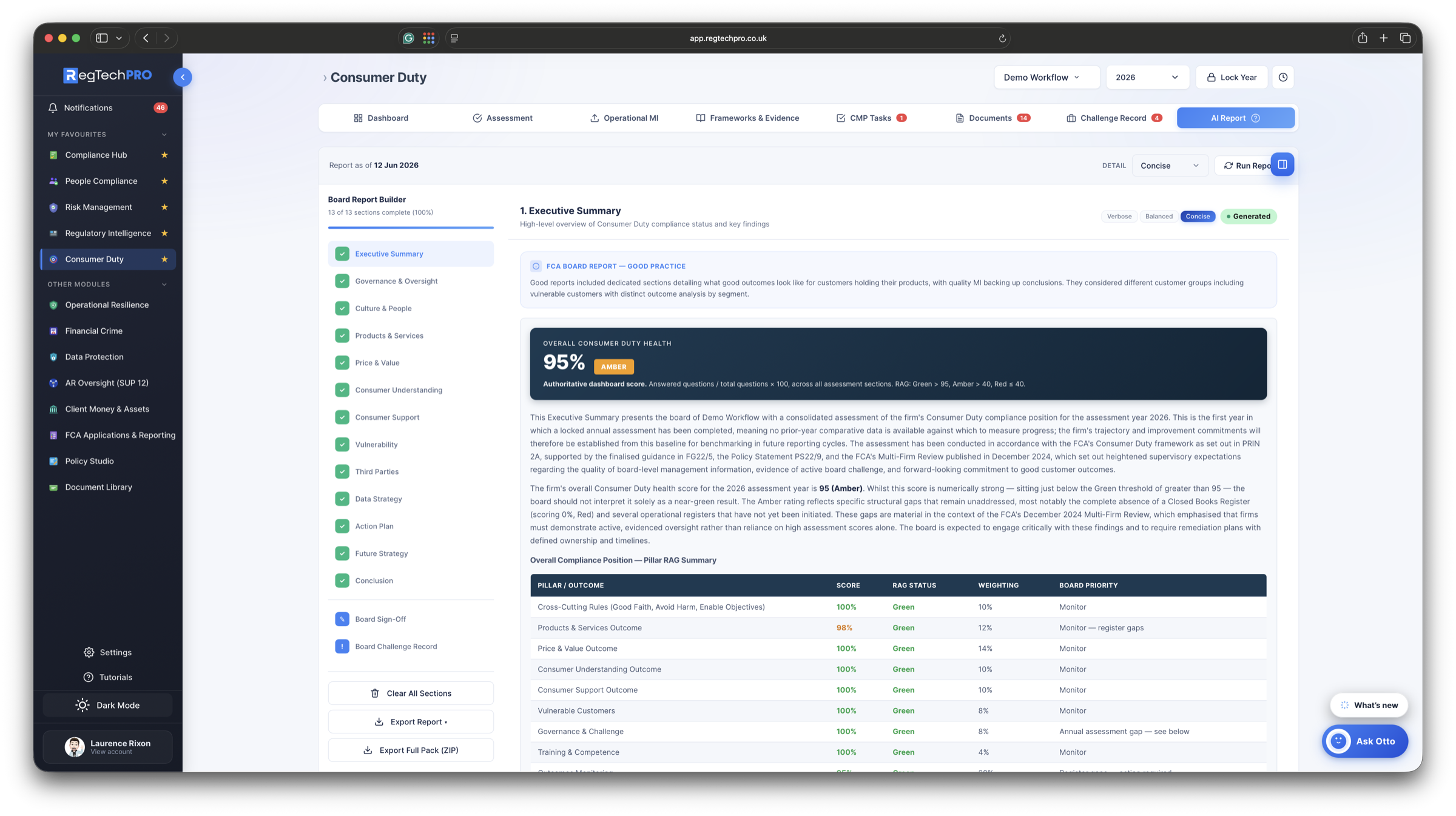
The 13-section annual board report, drafted from your live assessment data. Retail-investor outcomes, findings and actions — ready for challenge, not assembled the week before the board meeting.
A crowdfunding platform onboards at scale on both sides of the marketplace — investors and fundraisers alike need documented due diligence, screening and review. One module holds the lot.
Investors and fundraisers onboarded with documented CDD and KYC — risk-rated, reviewed on cadence and escalated to enhanced due diligence where warranted.
The CMP’s financial-crime chapters test the programme itself — CDD/KYC (B2), enhanced due diligence and PEPs (B3) and sanctions (B5) among them.
Your screening programme documented — lists, thresholds, cadence — with a hit log, frozen-assets and OFSI licence registers.
The records the MLRO annual report is built on, kept live — and Otto drafts the report itself from them when the year closes.
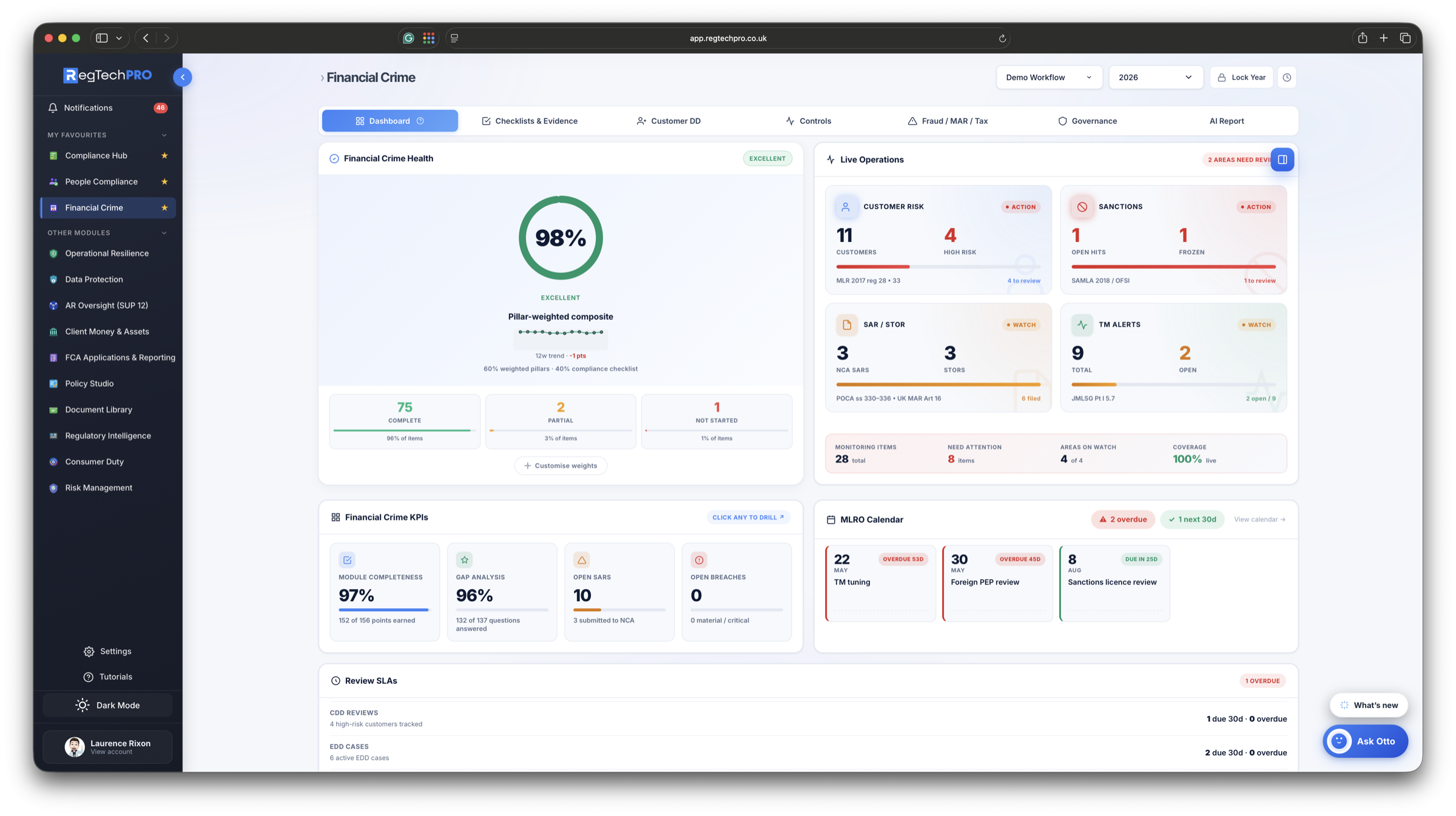
The MLRO’s morning glance. Financial Crime Health score, live operations across every regime, KPIs, the MLRO calendar and review SLAs — the whole function on one screen, every weakness one click from the work that fixes it.
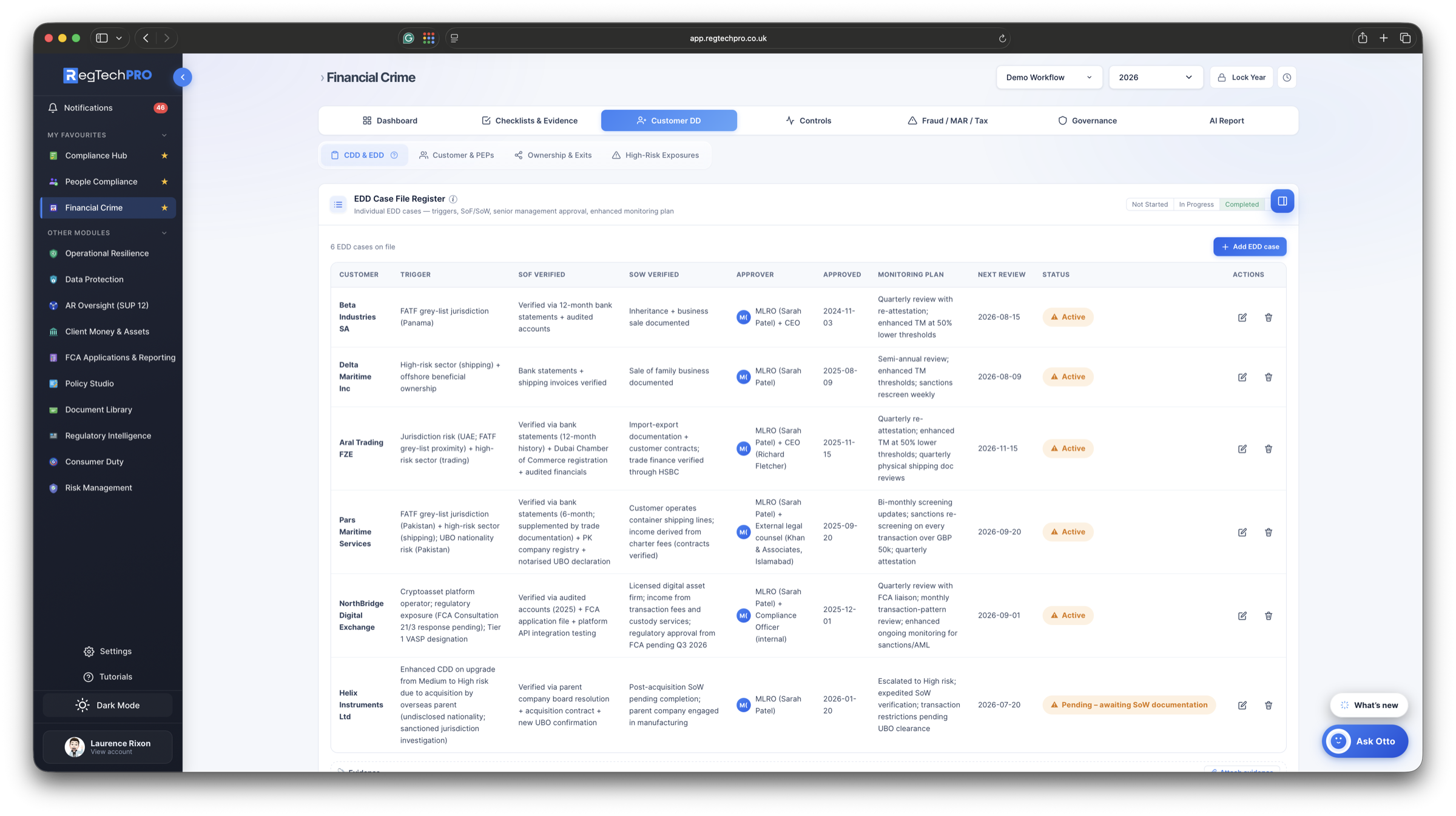
Due diligence as structured registers, not folders. CDD and KYC records with risk ratings, review dates and escalation paths — the onboarding evidence for both sides of your marketplace, current and exportable when the FCA asks.
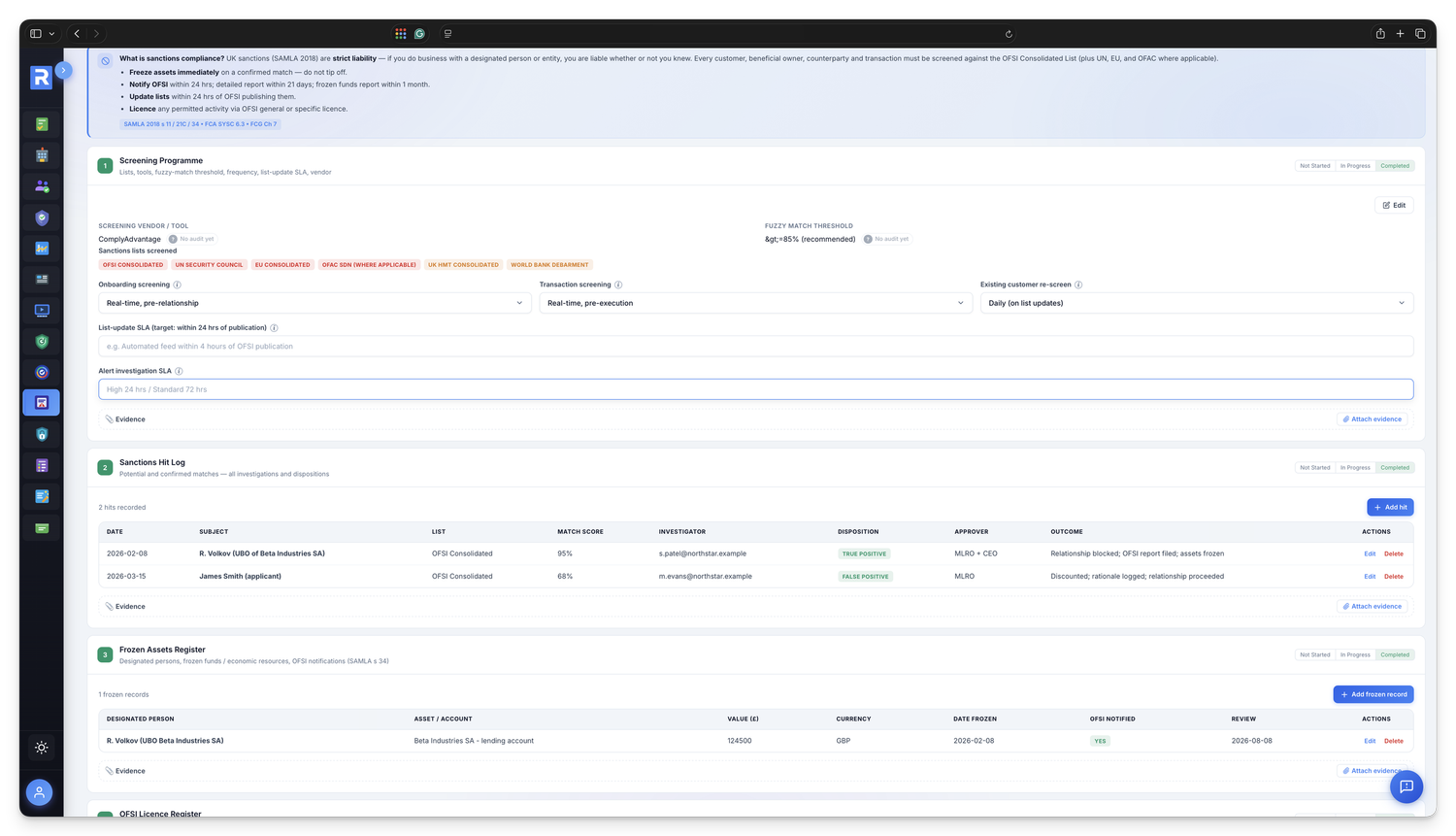
The sanctions workspace: your screening programme — lists, thresholds, cadence — documented in one place, a hit log with dispositions, frozen-assets and OFSI licence registers, and a breach log with the reporting route named from the start.
Otto is the platform’s built-in compliance advisor, grounded in 150+ expert-authored documents. She reads your live monitoring, Consumer Duty and financial-crime records — not a generic handbook summary — and drafts the reports the regulator expects to see.
Your year’s monitoring drafted from live data — the E11 chapter’s coverage, findings and remediation, section by section, with COBS and CONC among its 13 regulatory anchors.
The 13-section annual board report on retail-investor outcomes, drafted from your live assessment data — ready for challenge, not year-end assembly.
The MLRO annual drafted from your live financial-crime records — the CDD, screening and review evidence a two-sided marketplace generates, pulled into one report.
Ask about your COBS 14.4 obligations or your appropriateness posture and Otto answers from your live records — which checks are overdue, where the file is thin, what closes the gap.
AI drafts, humans decide — nothing is auto-submitted, and every fact traces to your live firm data.
Three ways to run crowdfunding compliance. Only one produces evidence the FCA can inspect — on the day they ask for it.
What a P2P or investment-crowdfunding platform director wants to know about running COBS 14.4 and CONC compliance in one place.
We use essential cookies to make the site work, and optional analytics cookies to understand how it's used. See our Cookie Policy.