
Consumer credit lenders — from motor finance to HCSTC — run affordability monitoring, arrears and forbearance evidence, fin-prom approvals and Consumer Duty reporting from one platform, with the audit trail the FCA expects.
14-day free trial · Take the tour
E6 + E7 dedicated CMP chapters
Maker-checker approval built in
Affordable Credit + Arrears & Default templates
Affordability, forbearance, the price cap, the Duty — the FCA doesn’t ask whether your book complies. It asks you to prove it, and the burden of proof sits with the lender.
Motor finance and BNPL have put creditworthiness at the top of the FCA’s agenda. CONC 5 expects the assessment on file, borrower by borrower — “we checked” isn’t evidence.
A promotion goes out; the approval lives in someone’s inbox. When the FCA asks who signed off the representative APR under CONC 3 — and when — the trail has to exist.
A Debt Respite Scheme moratorium lands and collections activity has to stop — interest, fees, enforcement, contact. If your process can’t show it stopped, on time, every time, that’s a breach in waiting.
Forbearance offered, vulnerability considered, a fair outcome reached — but CONC 7 expects each step recorded. When the arrears book is reviewed, if the file can’t show it, it didn’t happen.
The annual Consumer Duty board report is a standing obligation, not a one-off. Assembling it each year from scattered MI and inboxes is a quarter’s work — and it shows.
Policy statements, consultations and Handbook changes land weekly across 13 UK regulators — and lending is moving faster than most sectors, from motor-finance redress to the incoming BNPL regime. Missing the one that rewrites your obligations is how lenders fall behind.
Named chapters, registers, policy templates and filters for firms whose obligations run from creditworthiness at origination to forbearance in collections.
E6 Consumer Credit — Lending & Broking and E7 Debt Management & Debt Collection put 30 sector-specific checks into your monitoring plan — E6 covering creditworthiness under CONC 5 and the HCSTC price cap, E7 carrying the collections side of the book: arrears, default and the Debt Respite Scheme. All inside the 1,139-template library.
A register variant built for the CONC regime: every promotion logged, put through maker-checker approval before it runs, and closed with a timestamped audit trail — so “who approved this, and when?” is one filter away.
CONC and Arrears & Defaults attestation forms test your lending and collections arrangements directly against the Handbook — guided question sets, evidence attached, sign-off recorded.
Policy Studio ships an Affordable Credit Policy and an Arrears & Default Policy — drafted, reviewed and operationalised, so origination and collections run on documents that match what your firm actually does.
Regulatory Intelligence carries a dedicated Consumer Credit sector filter, keyword-mapped to CONC, motor finance, HCSTC and BNPL — and Otto scores each item’s relevance to your firm across the 13-regulator feed, so the story that reshapes your book surfaces first.
The A8 Consumer Duty chapter puts the Duty into your monitoring plan, and the Consumer Duty module turns the four outcomes into scored assessments and a 13-section annual board report — affordability and forbearance are exactly where the Duty bites for lenders.
The E6 and E7 credit chapters land in your programme complete — checks, owners, cadences and regulatory references, from origination through collections — with the registers and attestations lenders run alongside.
E6 Consumer Credit — Lending & Broking and E7 Debt Management & Debt Collection — creditworthiness to collections, anchored to CONC 2–8 and 10, the CCA 1974 and the HCSTC price cap.
74 regulation-anchored categories, including deep-dives on financial promotions (A12) and the Consumer Duty (A8).
The financial-promotions register in its CONC variant — maker-checker approval before anything runs, every decision timestamped.
CONC and Arrears & Defaults attestation forms with guidance in-form and sign-off recorded — your lending and collections arrangements declared, not reconstructed.
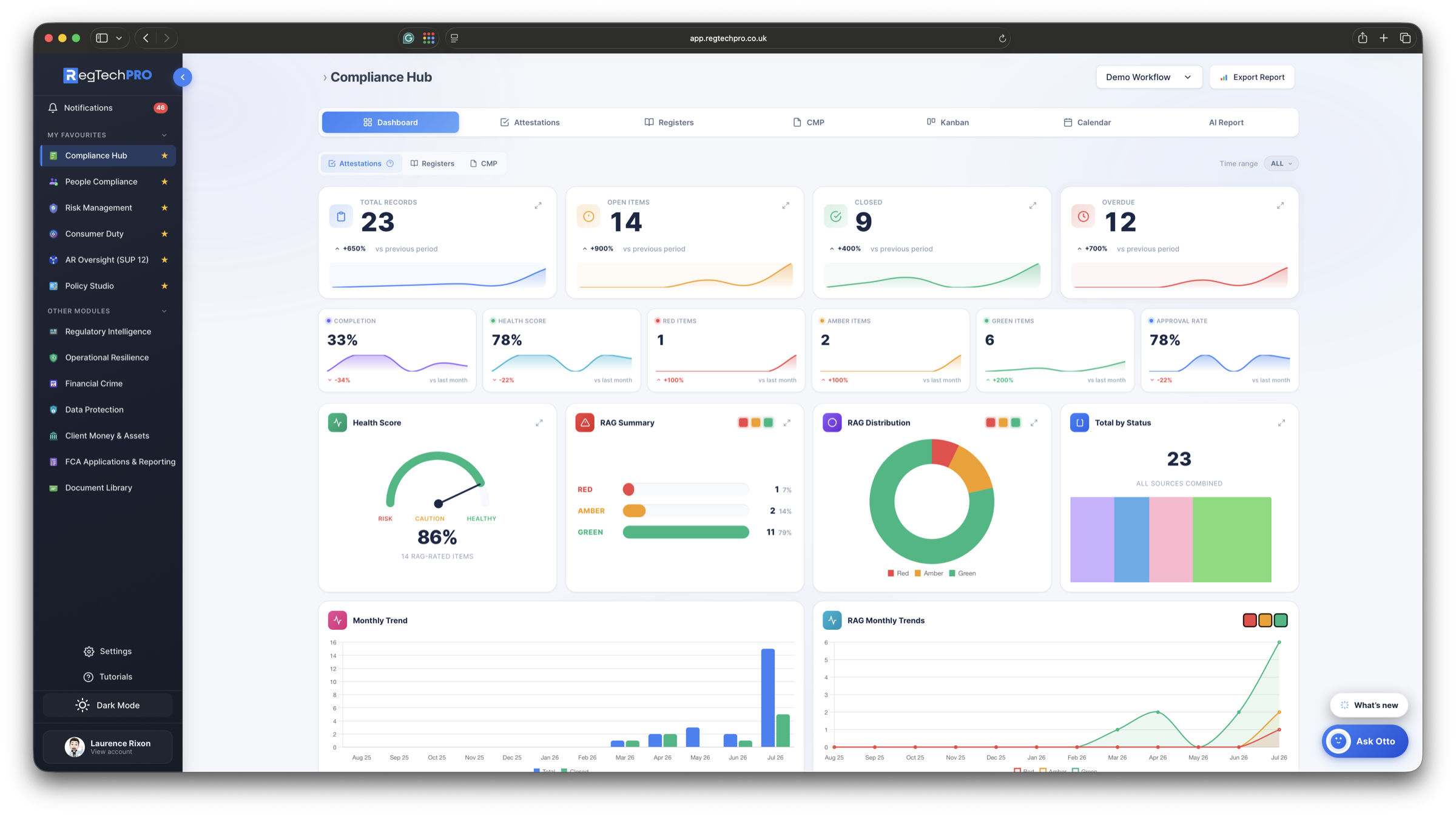
The head-of-compliance landing surface. Live KPI tiles for open, closed and overdue tasks, completion and approval rates, an overall Health Score, RAG summary and monthly trends — every tile a one-click drill-down to the records underneath.
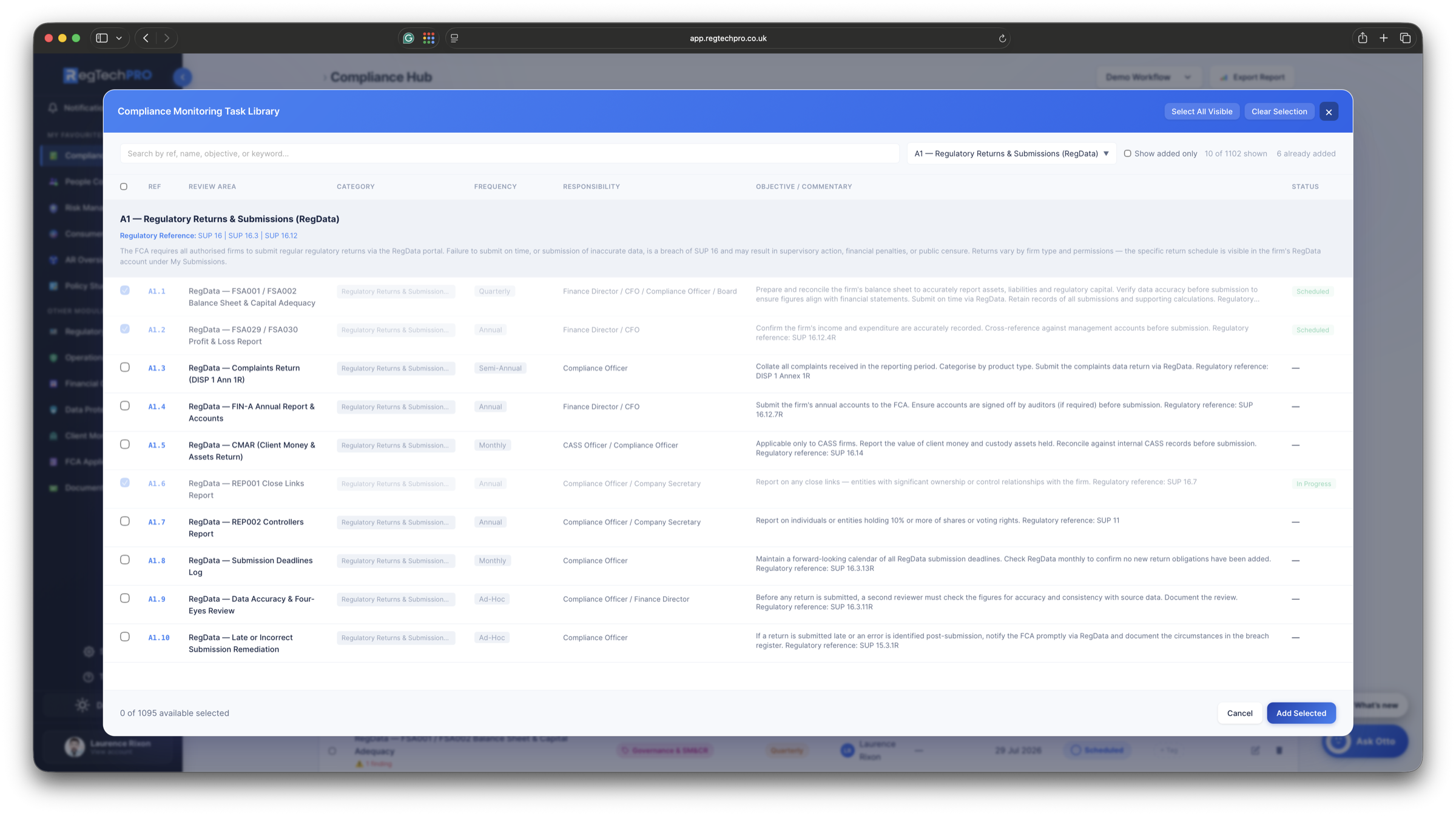
1,139 expert-built monitoring checks across 74 regulation-anchored categories — including the E6 and E7 credit chapters that carry your book from creditworthiness to collections, plus deep-dive chapters on financial promotions and the Consumer Duty. Each template ships with a regulatory reference chain and plain-English guidance that pre-populates in-form.
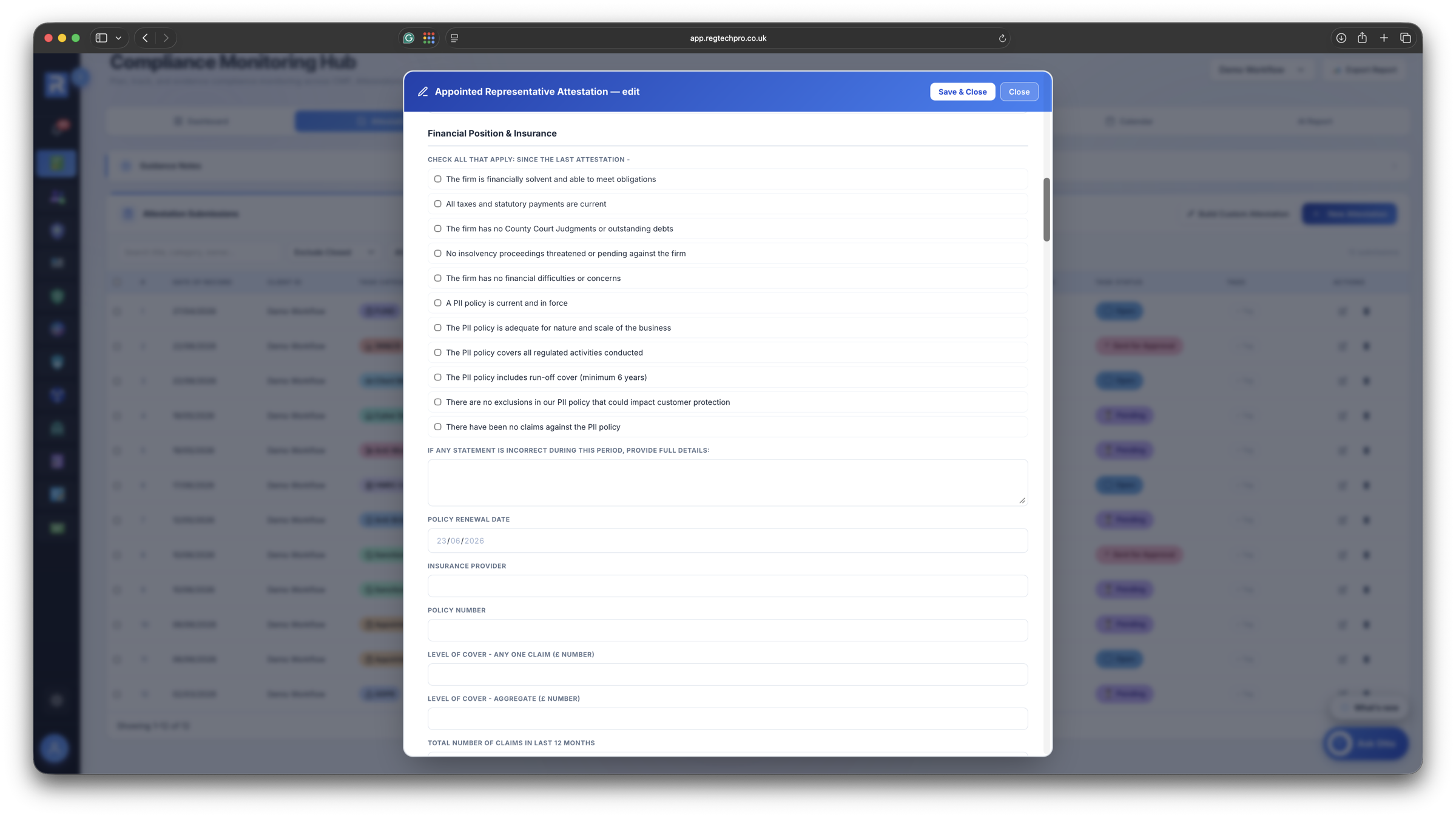
Every formal declaration, completed and signed off in-platform. Attestation forms for CONC and Arrears & Defaults — the two your lending book turns on — with the FCA Principles individually ticked and a maker-checker approval workflow. The form can’t be submitted until every obligation is signed off.
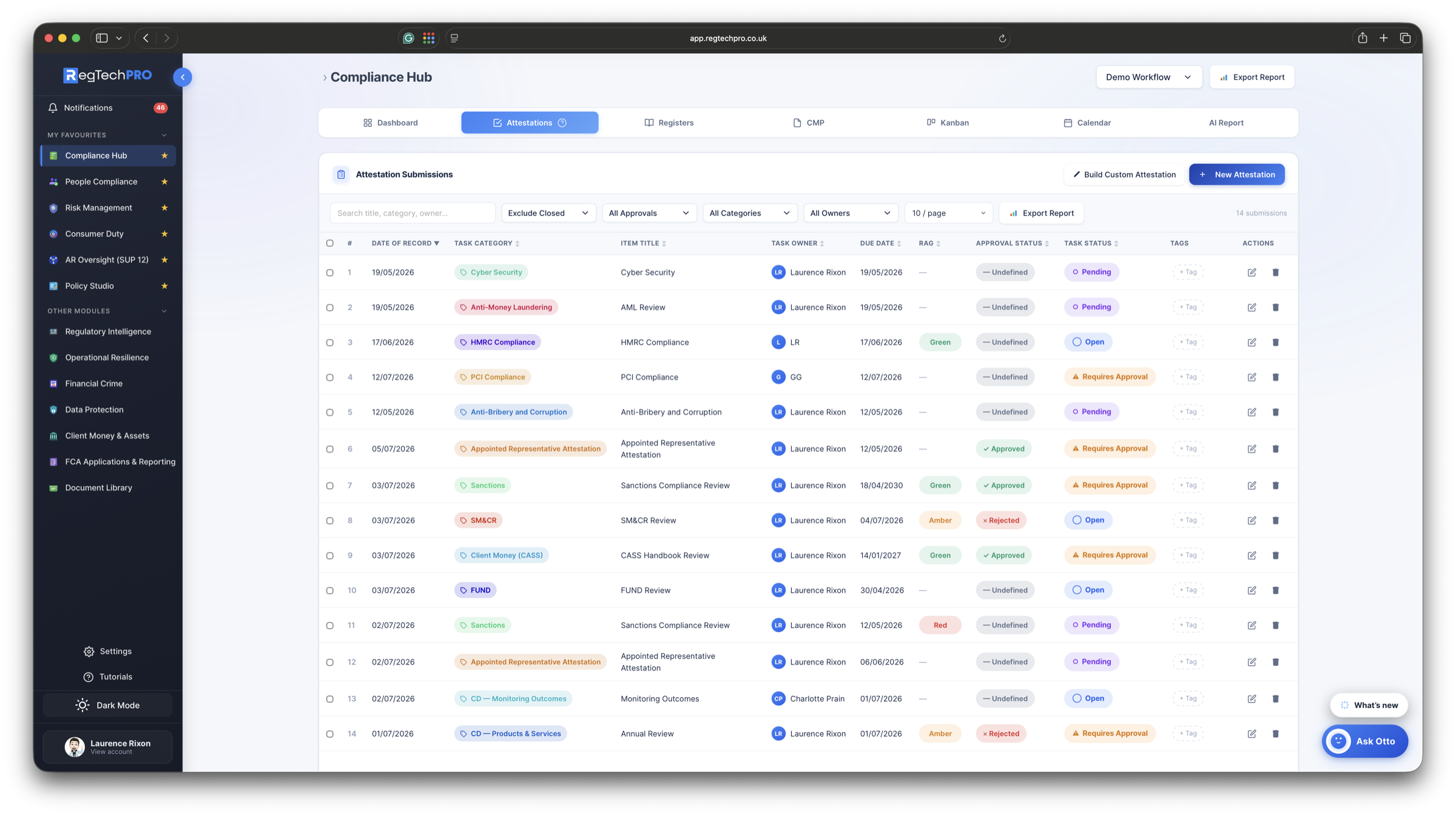
Every event your firm has to record, in one tracker. Financial promotions in their CONC variant, complaints, breaches, gifts & entertainment and conflicts — status chips, named owners, due dates and the same maker-checker approval workflow throughout.
Affordability, forbearance and price-and-value are exactly where the FCA looks at lenders. The Consumer Duty module turns PRIN 2A into scored assessments, live registers and a 13-section annual board report.
The four outcomes, cross-cutting rules and wider areas — each scored against FCA expectations with a named owner and evidence, plus 54 questions per product.
Otto drafts all 13 sections of the annual board report from your attested data, flagging Urgent Board Actions as she goes. Humans own the sign-off.
Complaints, trigger events, adverse outcomes, root-cause analysis and vulnerability — each linked to named owners and attached evidence.
The A8 Consumer Duty chapter drops Duty checks straight into the Compliance Monitoring Hub — the Duty monitored on a cadence, not remembered in Q1.
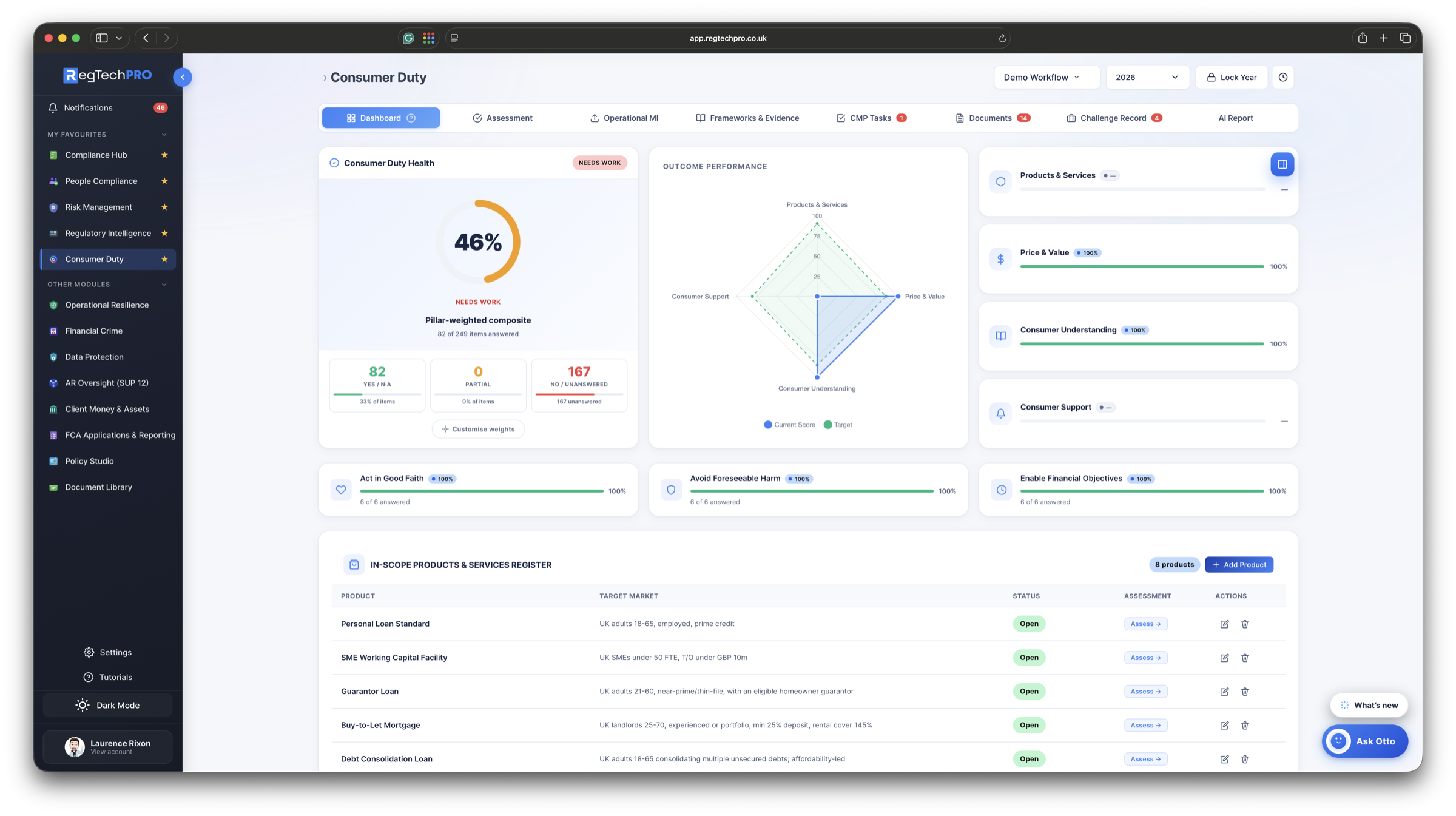
A 30-second status check for the whole firm: a Consumer Duty Health donut, the four-outcome performance radar against your own thresholds, the cross-cutting rules, the in-scope products & services register and quarter-on-quarter trend — every PRIN 2A obligation, one screen.
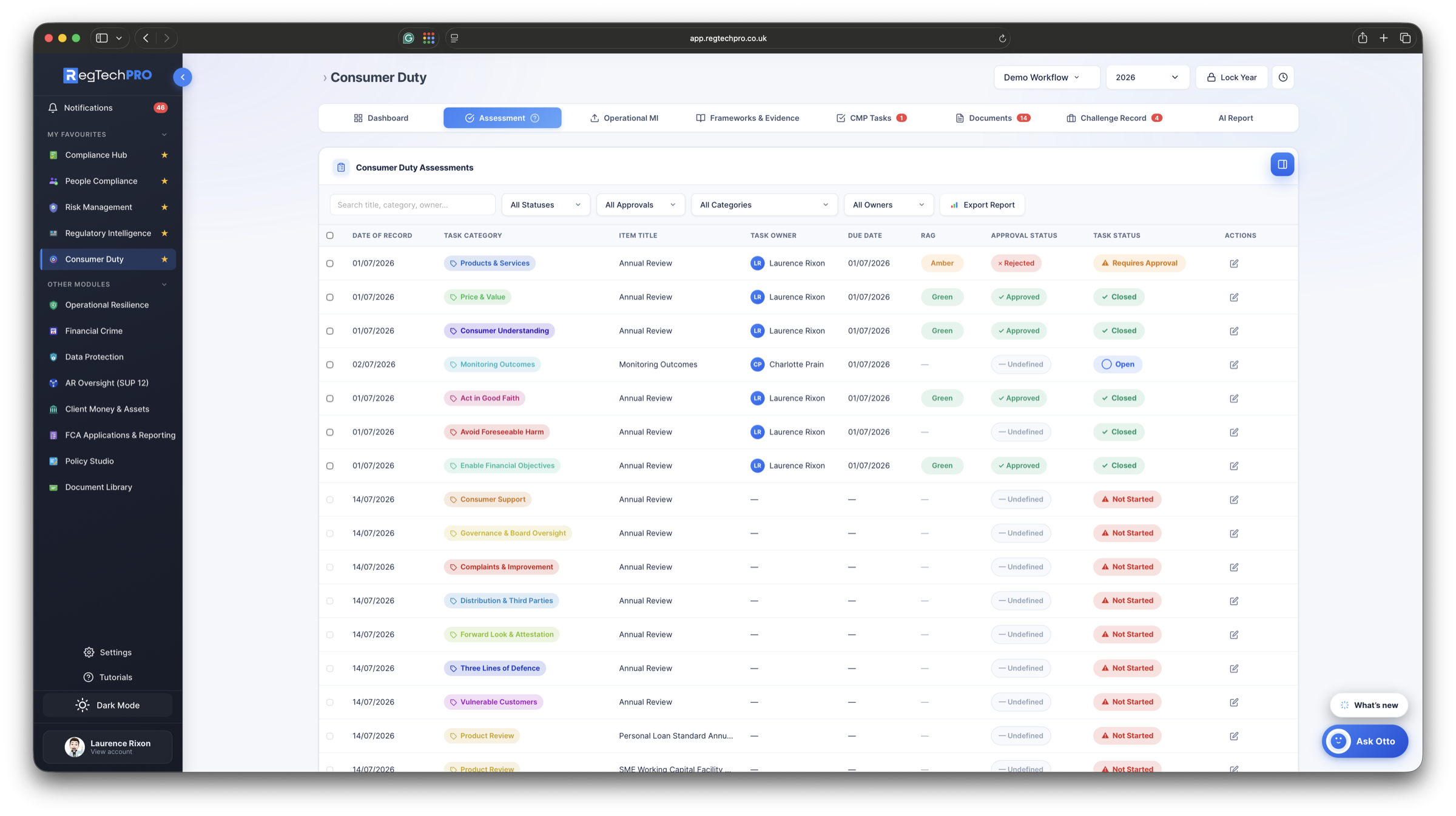
The full Consumer Duty assessment, chapter by chapter: the four outcomes, the cross-cutting rules and the wider areas — governance, monitoring, complaints, foreseeable harm and vulnerable customers — each scored against FCA expectations with a named owner and evidence. For a lender, this is where affordability and forbearance meet the Duty.
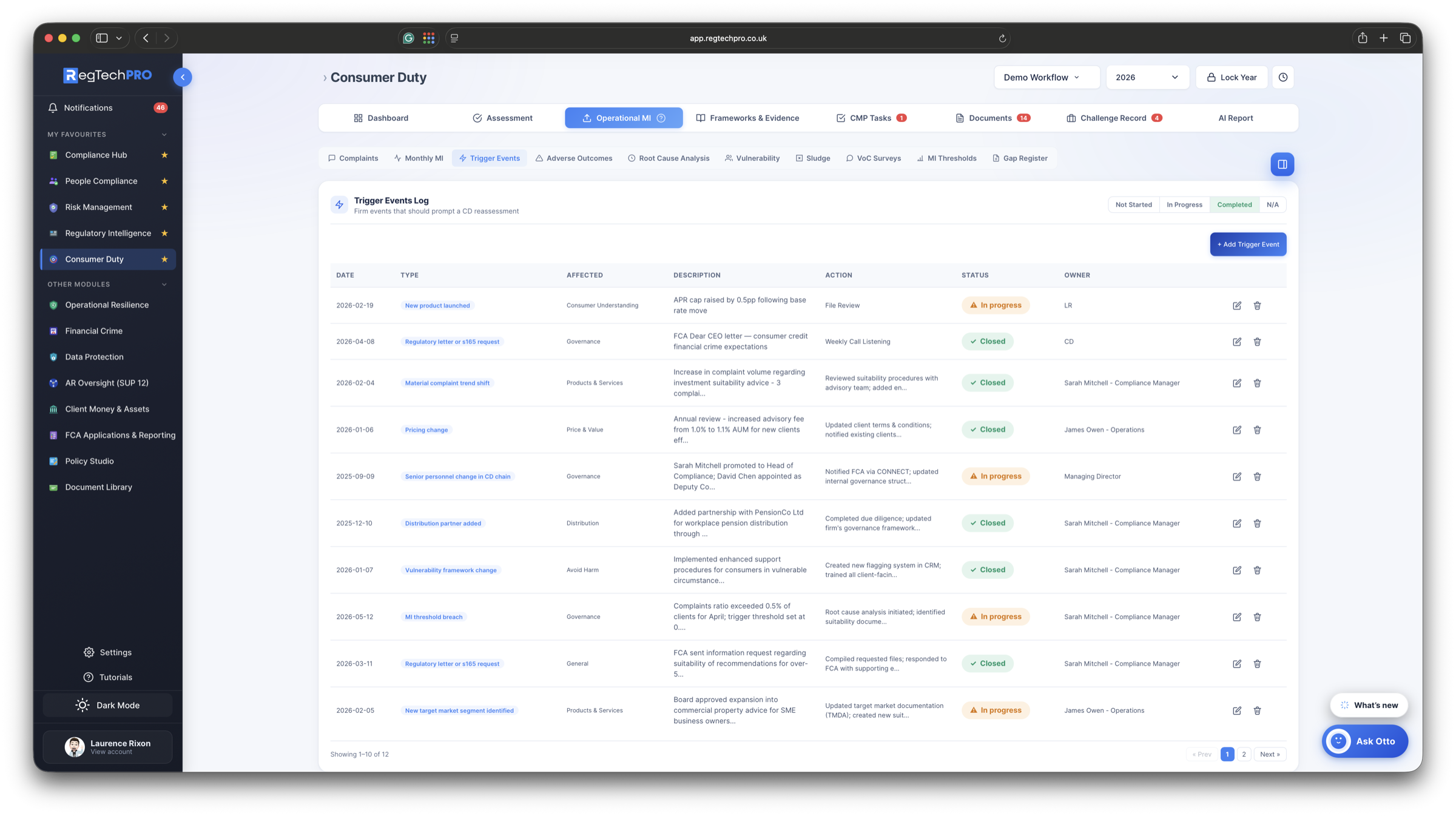
Every Consumer Duty register in one place: Complaints, Monthly MI, Trigger Events, Adverse Outcomes, Root Cause Analysis, Vulnerability, KPI Thresholds and the Gap Register — each linked to named owners and attached evidence, year-on-year traceable.
Lenders carry the full financial-crime load — customer due diligence at onboarding, application-fraud controls, transaction monitoring and sanctions — alongside the MLRO’s governance calendar. One module holds the lot.
Every borrower risk-rated, review-tracked and evidence-attached, with next-review dates and sanctions/EDD flags — so no stale file waits to be found.
Fraud sits as a regime in its own right alongside AML, sanctions and tax evasion — application-fraud controls documented, incidents logged, evidence attached.
Your monitoring programme documented as a regime — scenarios, alert triage and disposition — with the trail that shows it runs in practice.
MLRO oversight, the operating calendar, the business-wide risk assessment and a 10-policy library — the governance layer the FCA asks about first.
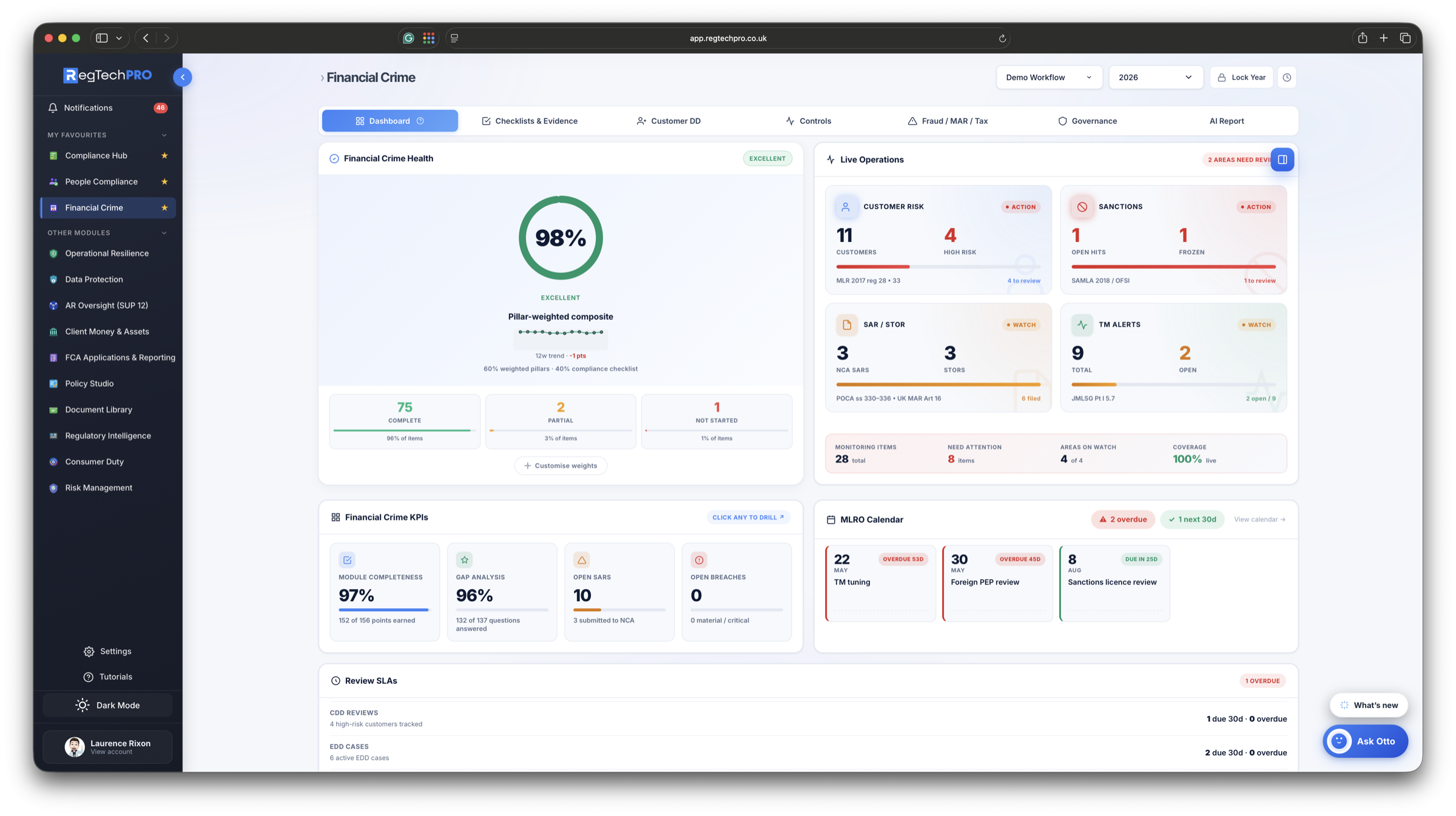
The MLRO’s morning glance. Financial Crime Health score, live operations across every regime, KPIs, the MLRO calendar and review SLAs — the whole function on one screen, every weakness one click from the work that fixes it.
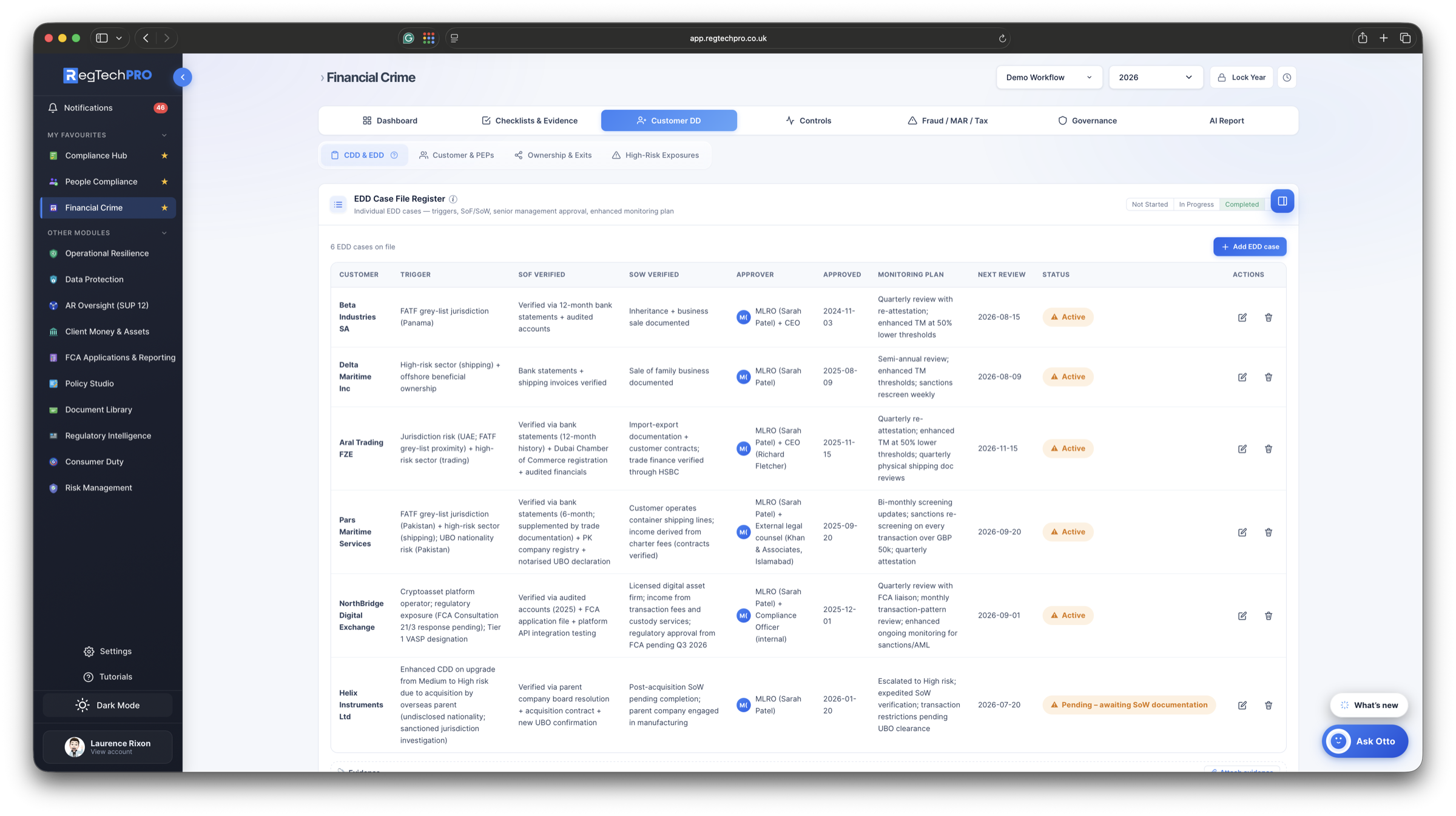
Every customer, PEP and case in one register. Risk-rated, review-tracked and evidence-attached, with next-review dates and sanctions/EDD flags — so a stale file never reaches the regulator’s eye first.
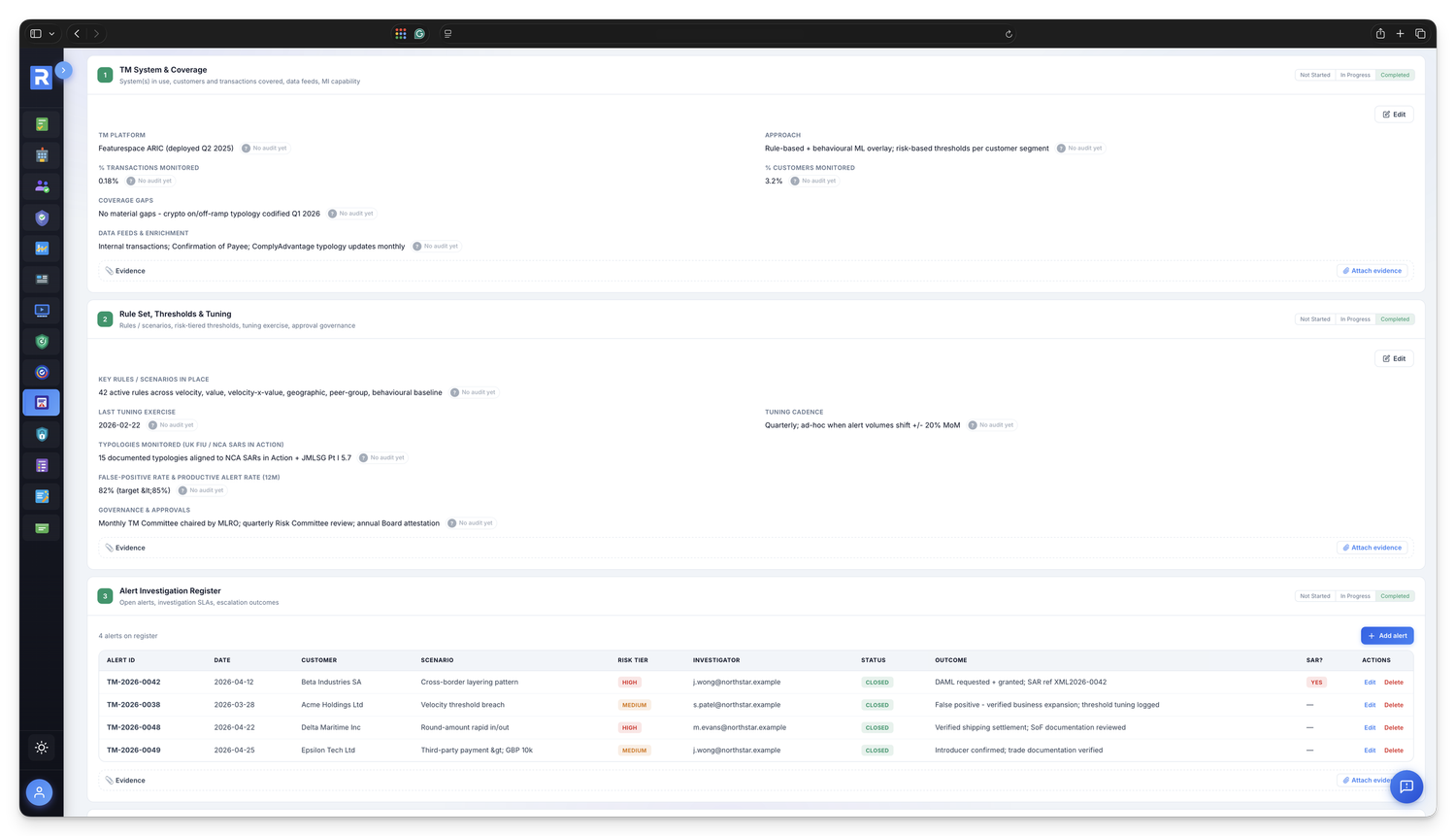
Transaction monitoring as a documented regime: the programme, monitored scenarios and alert triage tracked to disposition — the audit trail that shows your controls run in practice, not just on paper.
Otto is the platform’s built-in compliance advisor, grounded in 150+ expert-authored documents. She reads your live monitoring, Consumer Duty and financial-crime records — not a generic handbook summary — and drafts the reports the regulator expects to see.
Your year’s monitoring drafted from live data, citing CONC among its 13 regulatory anchors — coverage, findings and remediation, section by section.
All 13 sections of the annual board report drafted from your attested Duty data, with Urgent Board Actions flagged as she goes.
The MLRO annual drafted from your live financial-crime records, with fraud as a standing pillar alongside AML and sanctions.
Ask Otto to draft or refresh your Affordable Credit and Arrears & Default policies in Policy Studio — you review, refine and operationalise.
AI drafts, humans decide — nothing is auto-submitted, and every fact traces to your live firm data.
Three ways to run lending-book compliance. Only one produces evidence the FCA can inspect — on the day they ask for it.
What a lender’s owner-director or compliance lead wants to know — from affordability files to forbearance evidence.
We use essential cookies to make the site work, and optional analytics cookies to understand how it's used. See our Cookie Policy.