
Claims management companies run CMCOB monitoring, client-money protection under CASS 13 and Consumer Duty evidence from one platform — with the audit trail the FCA expects.
14-day free trial · Take the tour
E12 dedicated CMP chapter
Reconciliations + acknowledgement letters
238-question assessment + board report
Fee caps, disclosures, client money, complaints — since the Financial Guidance and Claims Act 2018 brought CMCs under the FCA, the burden of proof sits with the firm.
The PS20/8 fee cap and CMCOB’s disclosure rules assume you can show, customer by customer, what was disclosed and what was charged. “We always do” isn’t evidence.
Hold client money — even briefly — and CASS 13 applies: acknowledgement letters, segregation, reconciliations. The FCA expects each one documented, not described.
Claims businesses generate complaints at volume. DISP 1 expects each one logged, owned and resolved on deadline — a spreadsheet that’s out of date by Friday can’t show that.
The Consumer Duty applies to CMCs in full — and PRIN 2A.9 expects an annual board report. Assembling one from scattered files each year is a week nobody has.
Complaints, breaches, conflicts, gifts — scattered across files nobody reconciles. When the FCA asks for the register, version-controlled chaos isn’t an answer.
Policy statements, consultations and Handbook changes land weekly across 13 UK regulators. Missing the one that rewrites your obligations is how firms fall behind.
A dedicated CMC chapter, a CASS 13 client-money engine and the registers and reports the FCA expects a claims management company to keep.
E12 Claims Management Companies puts 15 sector-specific checks into your monitoring plan — anchored to CMCOB 2–8, section 419A FSMA, the Financial Guidance and Claims Act 2018, DISP 1 and the PS20/8 fee cap. All inside the 1,139-template library spanning 74 categories.
Acknowledgement letters under CASS 13.5, client-money reconciliations under CASS 13.10 and the records behind the CMC001 annual client-money return — plus a resolution pack kept mapped and retrievable, not assembled under pressure.
CMCs are squarely in scope of the Duty. A 238-question assessment scores your firm against all four outcomes, and Otto drafts the 13 sections of the PRIN 2A.9 Annual Board Report from your live records — review, sign, export.
The complaints register carries your DISP 1 record — owners, deadlines and outcomes — alongside a breaches register, each with maker-checker approval and a timestamped audit trail. “Show me the register” takes seconds, not days.
Regulatory Intelligence monitors 13 UK regulators in one hourly feed — and Otto reads each item against your firm’s profile and scores its relevance, so the consultation that rewrites CMCOB surfaces at the top, not on page four.
The E12 Claims Management Companies chapter lands in your programme complete — checks, owners, cadences and regulatory references — with the complaints and breaches registers CMCs run alongside.
The E12 Claims Management Companies chapter — anchored to CMCOB 2–8, s419A FSMA, FGCA 2018, DISP 1 and the PS20/8 fee cap.
74 regulation-anchored categories across 8 regulators — the E12 chapter arrives with owners, cadences and guidance already in place.
Every complaint logged with a named owner, deadline and outcome — the DISP record the FCA asks for first, current on the day it asks.
Breaches, conflicts and gifts & entertainment as structured registers — status chips, named owners and maker-checker approval throughout.
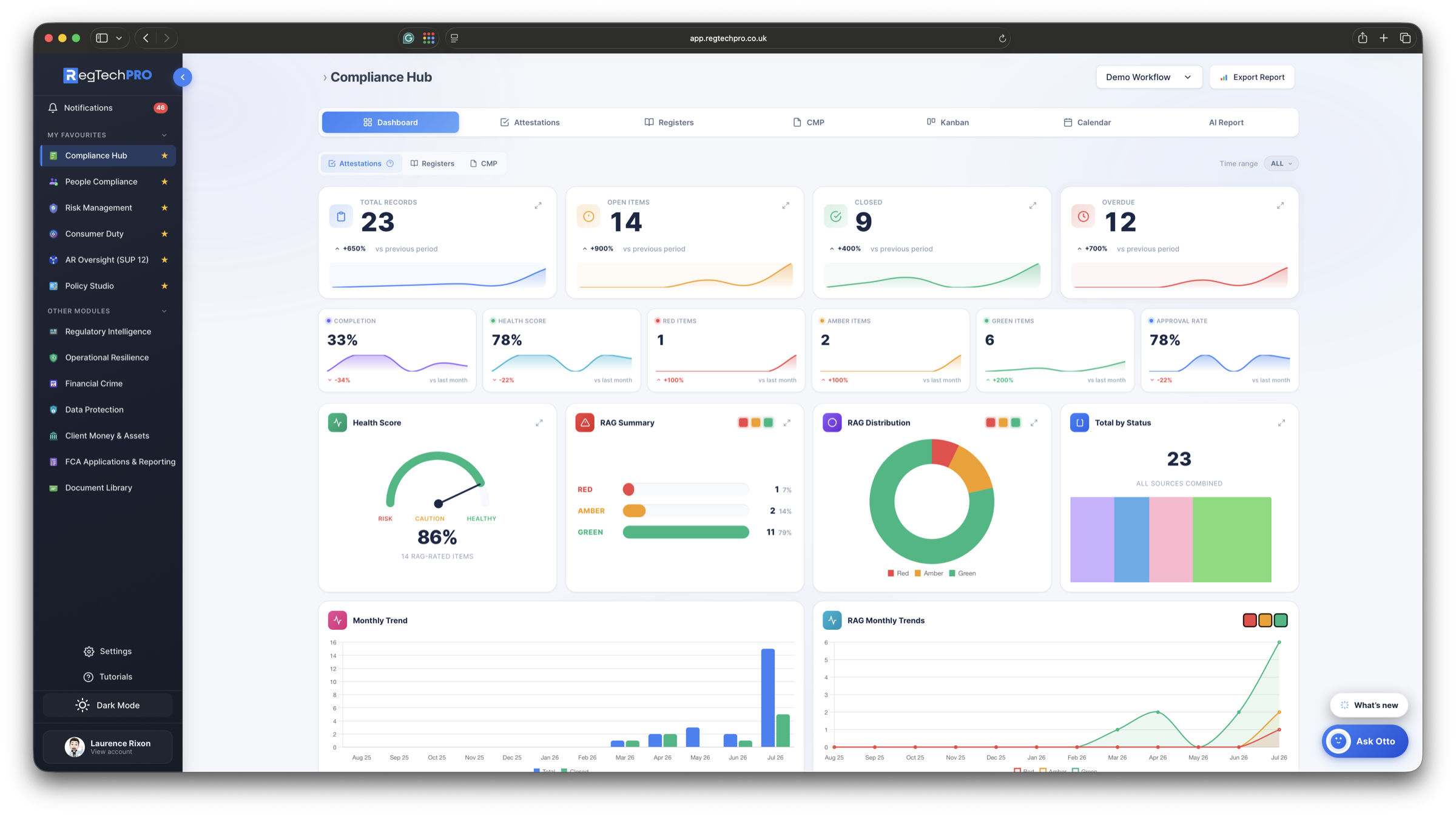
The head-of-compliance landing surface. Live KPI tiles for open, closed and overdue tasks, completion and approval rates, an overall Health Score, RAG summary and monthly trends — every tile a one-click drill-down to the records underneath.
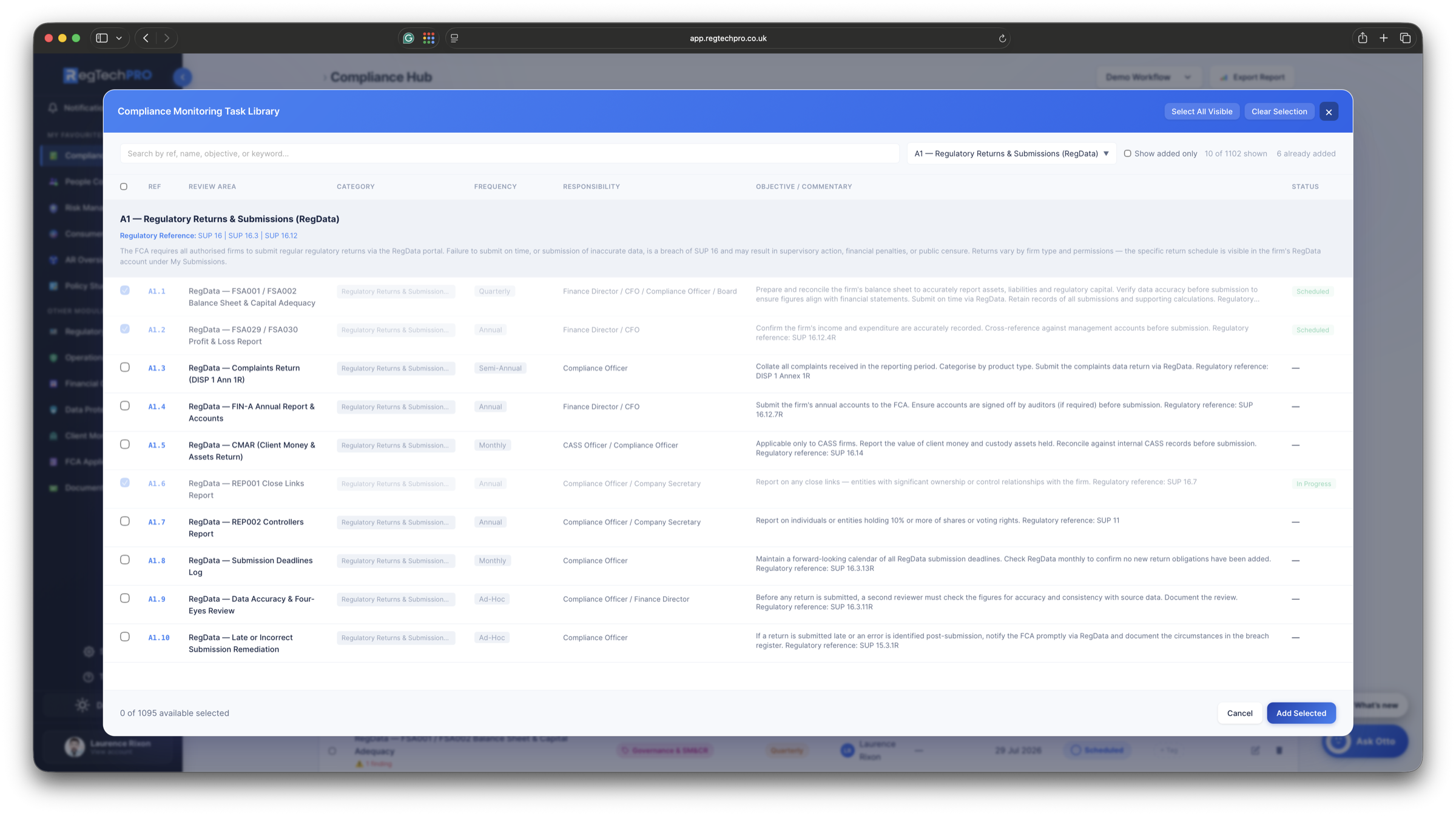
1,139 expert-built monitoring checks across 74 regulation-anchored categories — including the E12 Claims Management Companies chapter, 15 checks anchored to CMCOB 2–8, DISP 1 and the PS20/8 fee cap. Each template ships with a regulatory reference chain and plain-English guidance that pre-populates in-form.
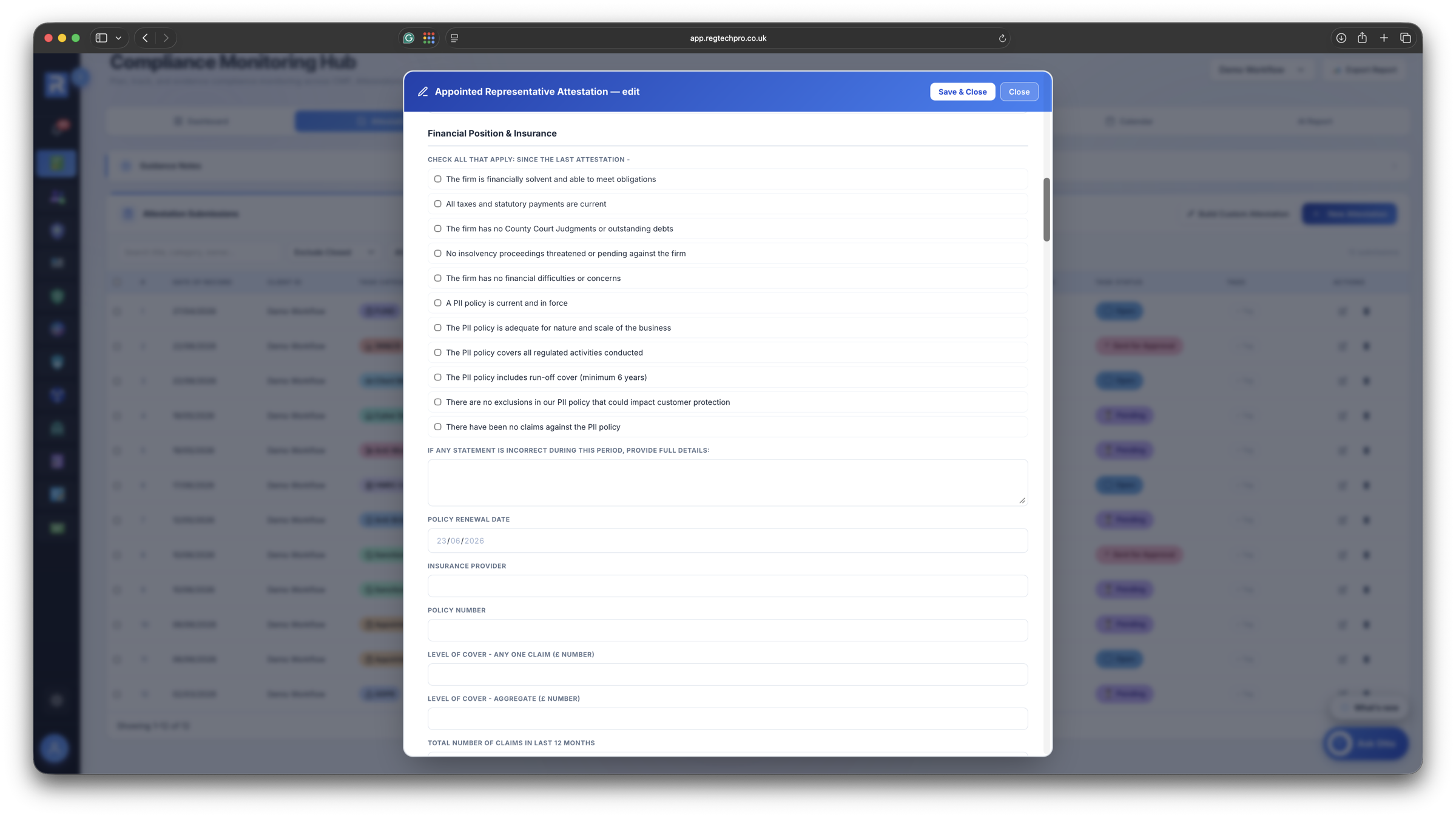
Every formal declaration, completed and signed off in-platform. Attestation forms with the FCA Principles individually ticked and a maker-checker approval workflow — the form can’t be submitted until every obligation is signed off.
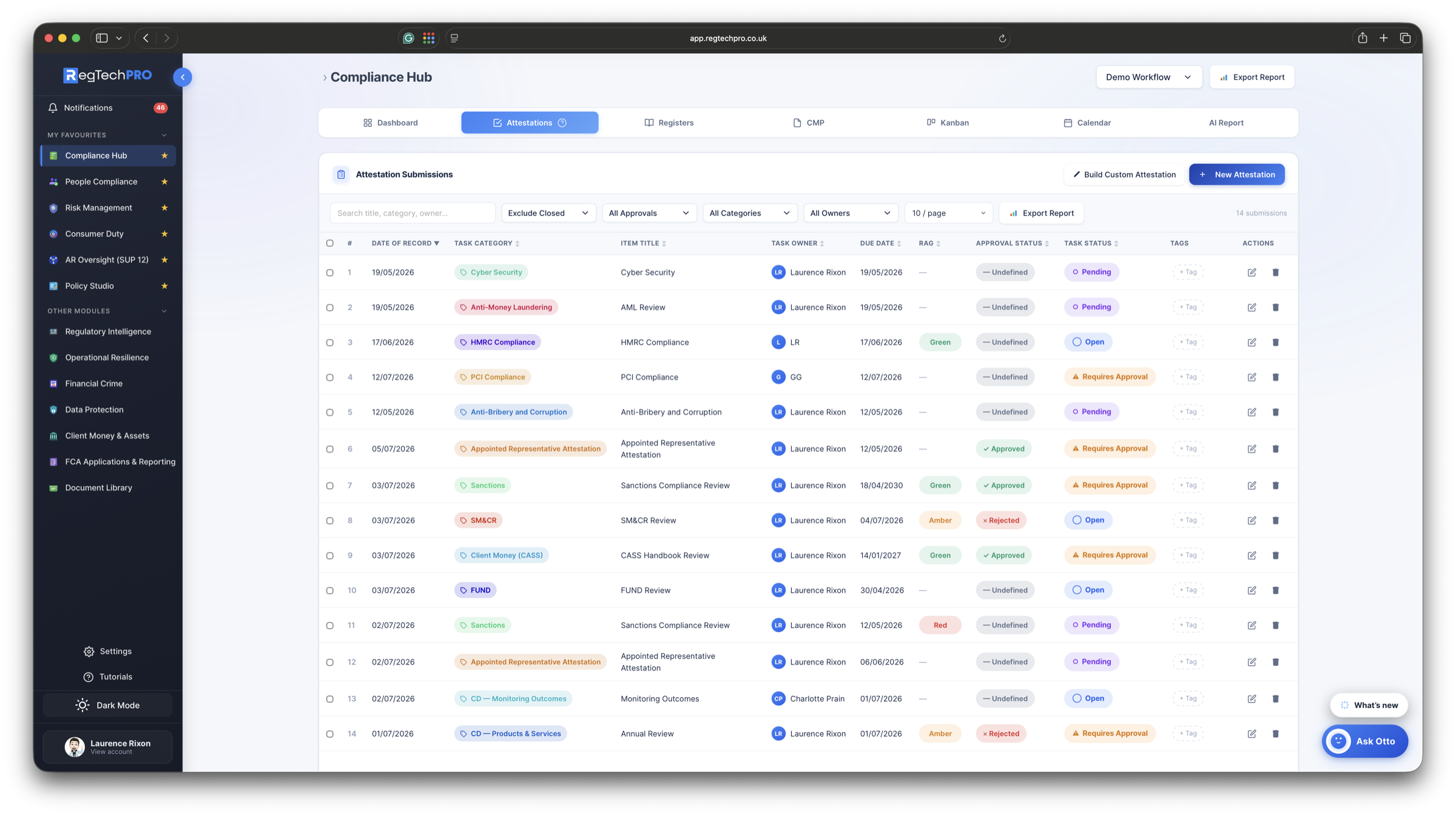
Every event your firm has to record, in one tracker. Complaints under DISP 1, breaches, gifts & entertainment and conflicts — status chips, named owners, due dates and the same maker-checker approval workflow throughout.
When a CMC holds client money, CASS 13 follows — acknowledgement letters, reconciliations and the records behind the CMC001 return, run on a dedicated engine instead of a spreadsheet.
Client-money reconciliations under CASS 13.10, logged with discrepancies and shortfalls flagged and tracked to resolution.
Client bank accounts tracked with acknowledgement-letter status under CASS 13.5 — plus bank concentration at a glance.
The records behind the annual client-money return kept current all year — compiled from live data, not reconstructed at year-end.
Every required document mapped and retrievable, with a readiness gauge and a one-click master document.
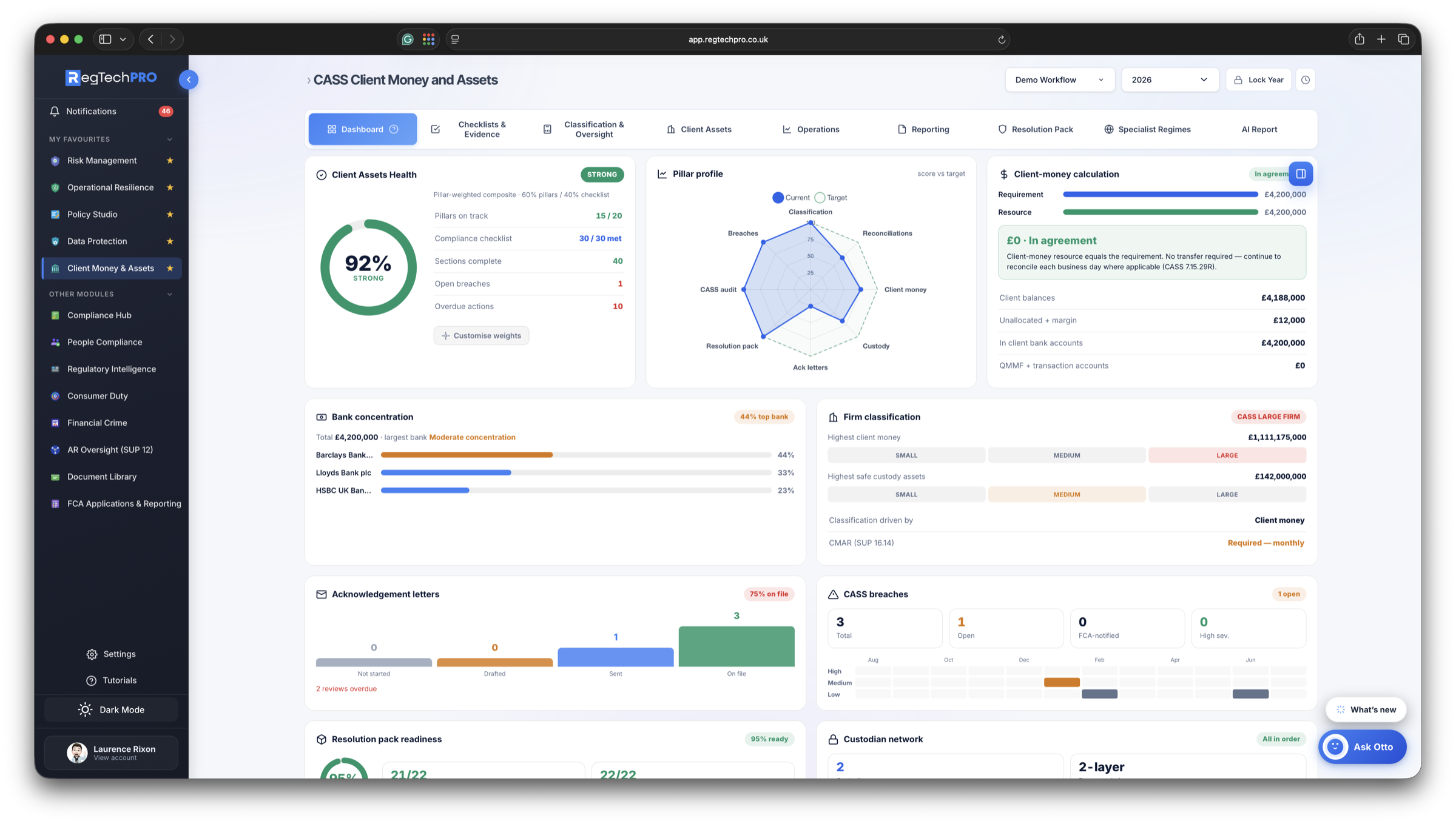
The whole client-money position on one screen. A Client Assets Health score with a pillar-by-pillar profile, and live tiles for bank concentration, the client-money position, resolution-pack readiness and a 12-month breach heat-map — every obligation, RAG-rated, at a glance.
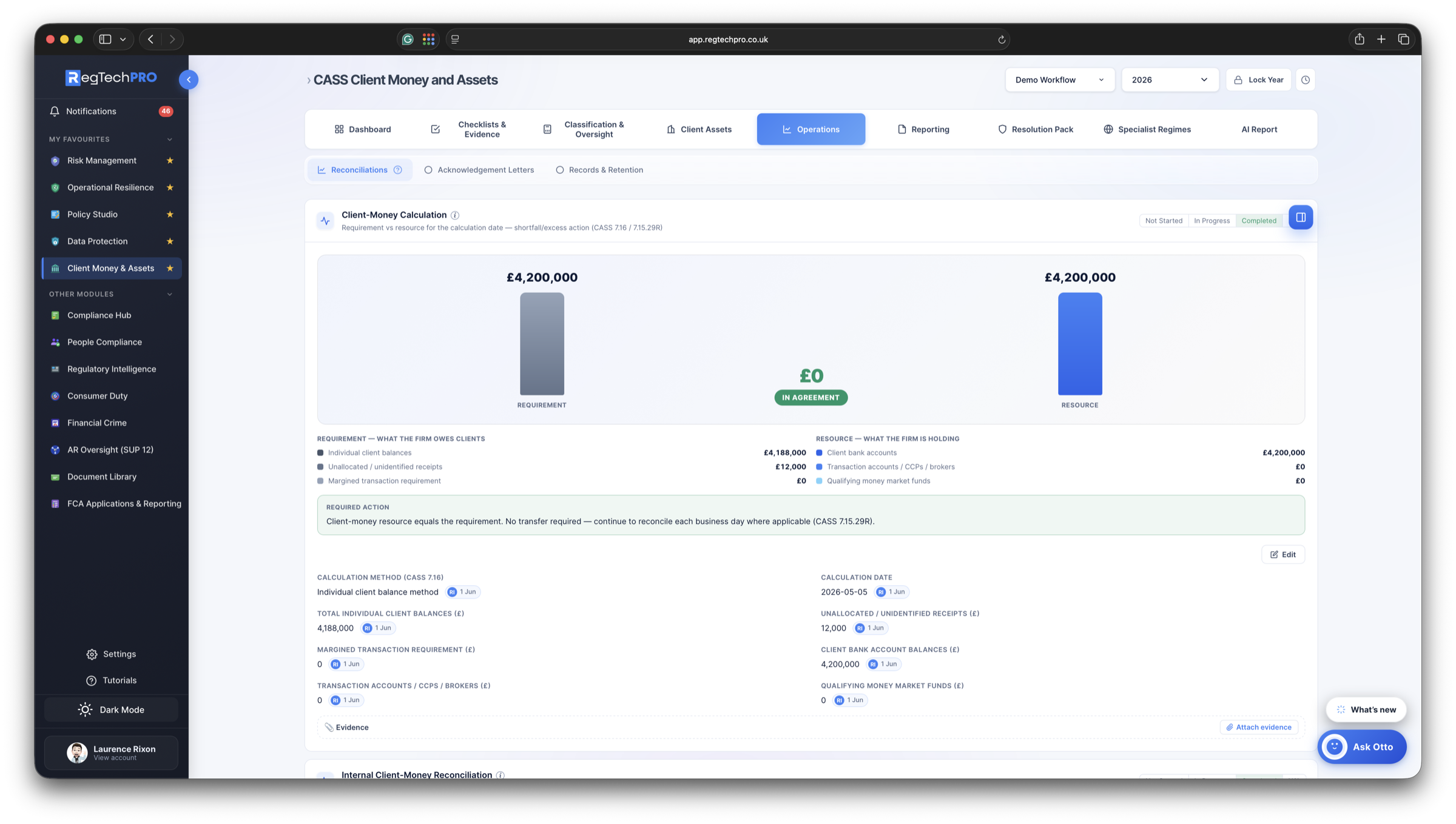
The reconciliation engine behind CASS 13.10. Log each client-money reconciliation, flag discrepancies and shortfalls, and track them to resolution — a record kept current and exportable, not rebuilt on the day the FCA asks for it.
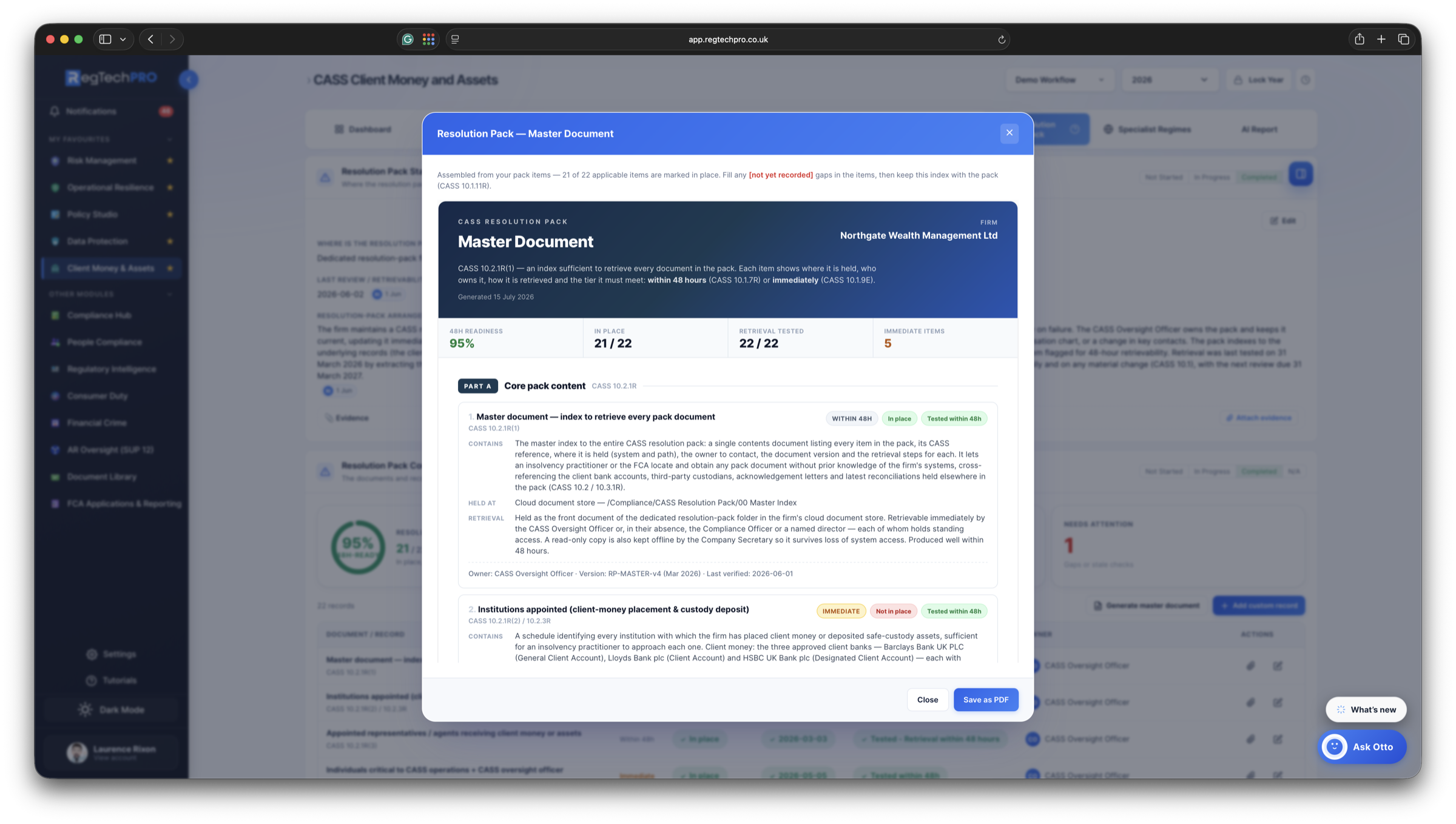
The resolution pack, mapped and retrievable. Every required document and record flagged for retrieval, with a readiness gauge and a one-click master document an insolvency practitioner could act on — assembled continuously, not under pressure.
CMCs are squarely in scope of the Duty. Score your firm against all four outcomes, evidence the gaps — and let Otto draft the annual board report from your live records.
Your firm scored against the four outcomes, the cross-cutting rules and the wider areas — each answer with a named owner and evidence.
Products & Services, Price & Value, Consumer Understanding and Consumer Support — performance against your own thresholds, on one radar.
A 20-question Vulnerable Customers area structured around FG21/1’s four drivers of vulnerability — a standing exam focus for CMCs.
Otto drafts the 13 sections of the Annual Board Report from your live records in 60 seconds — review, sign, export.
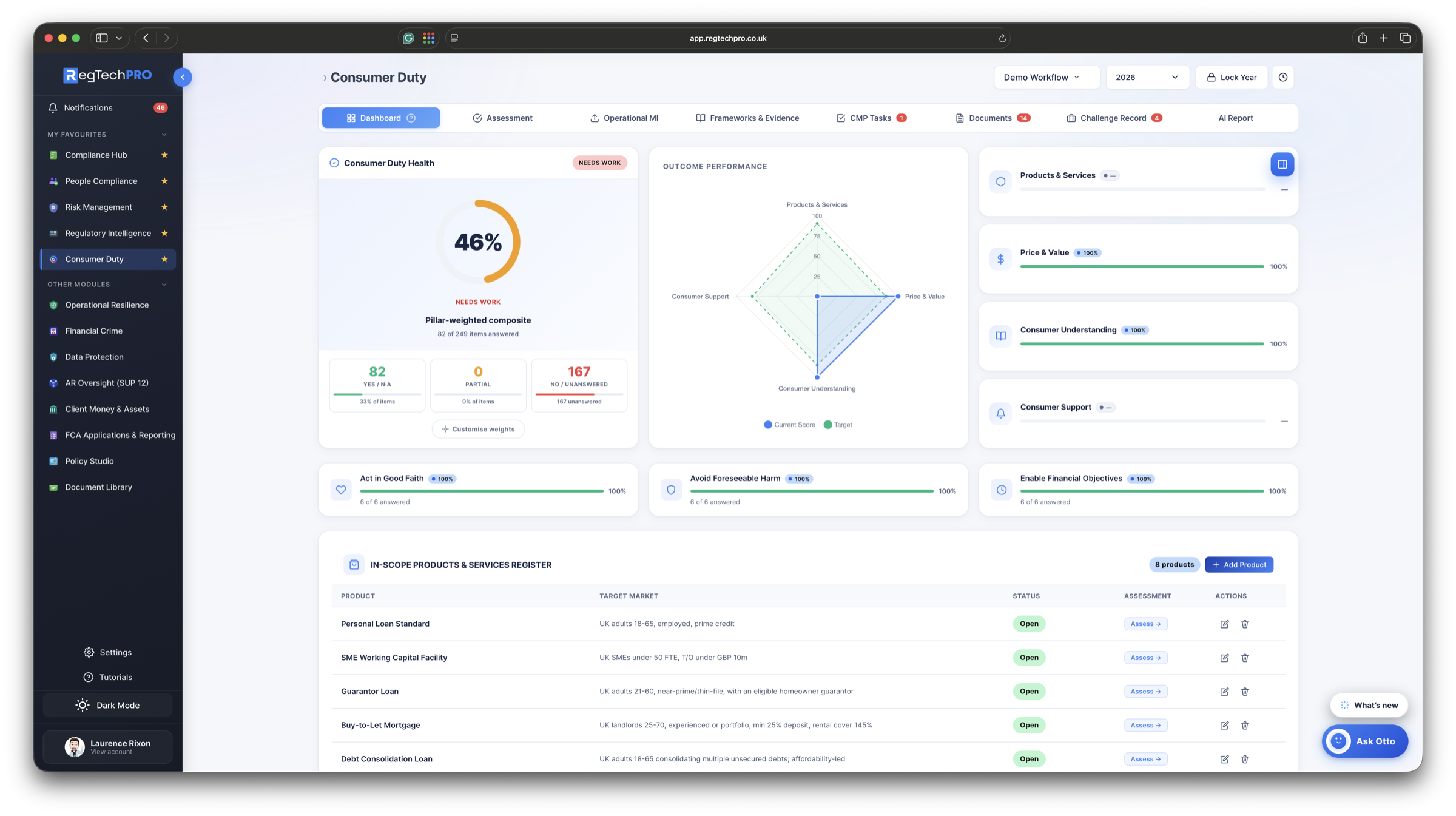
A 30-second status check for the whole firm: a Consumer Duty Health donut, the four-outcome performance radar against your own thresholds, the cross-cutting rules, the in-scope products & services register and quarter-on-quarter trend — every PRIN 2A obligation, one screen.
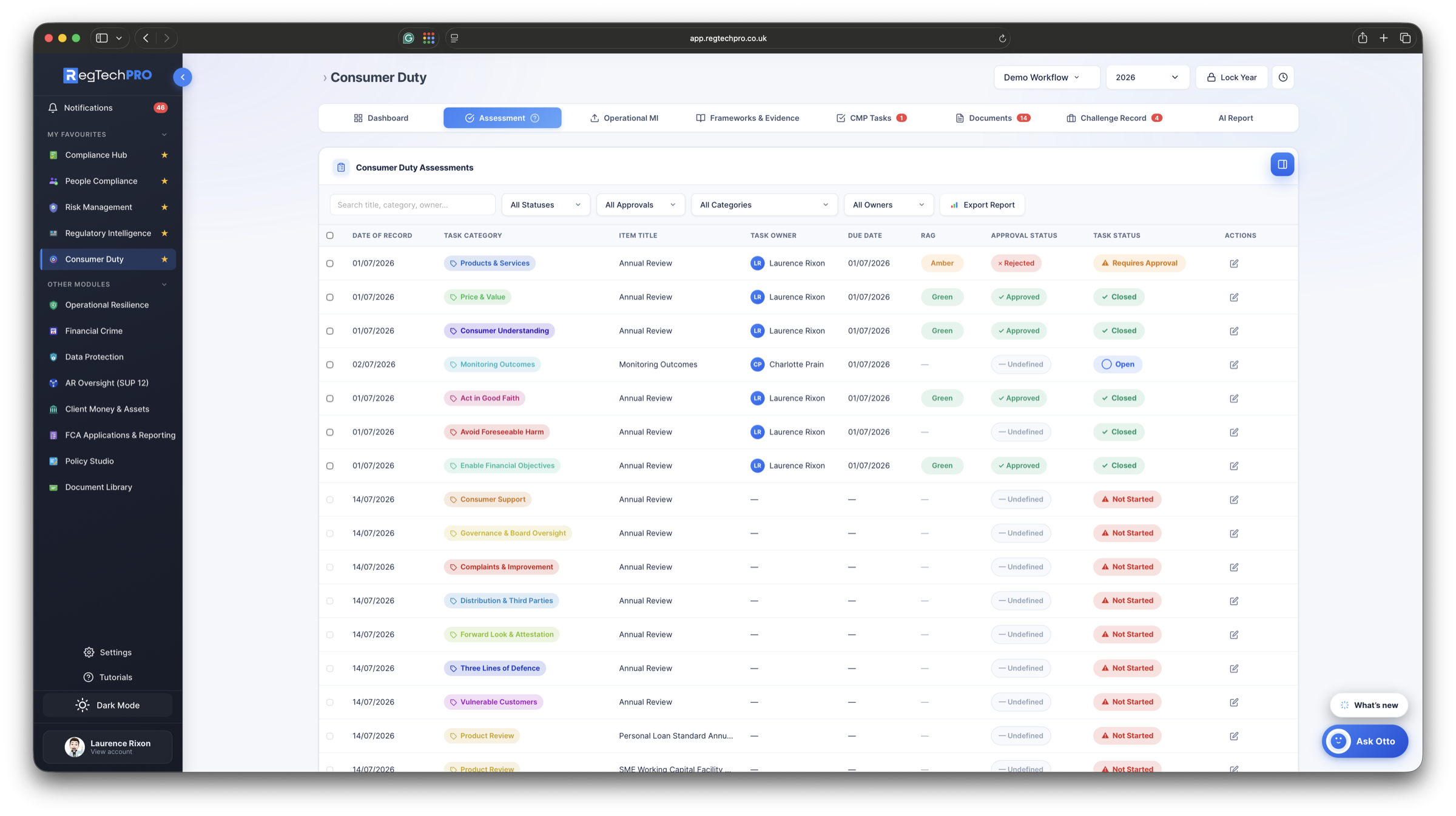
The full Consumer Duty assessment, chapter by chapter: the four outcomes, the cross-cutting rules, and the wider areas — governance, monitoring, complaints, third parties, foreseeable harm and vulnerable customers — each scored against FCA expectations with a named owner and evidence.
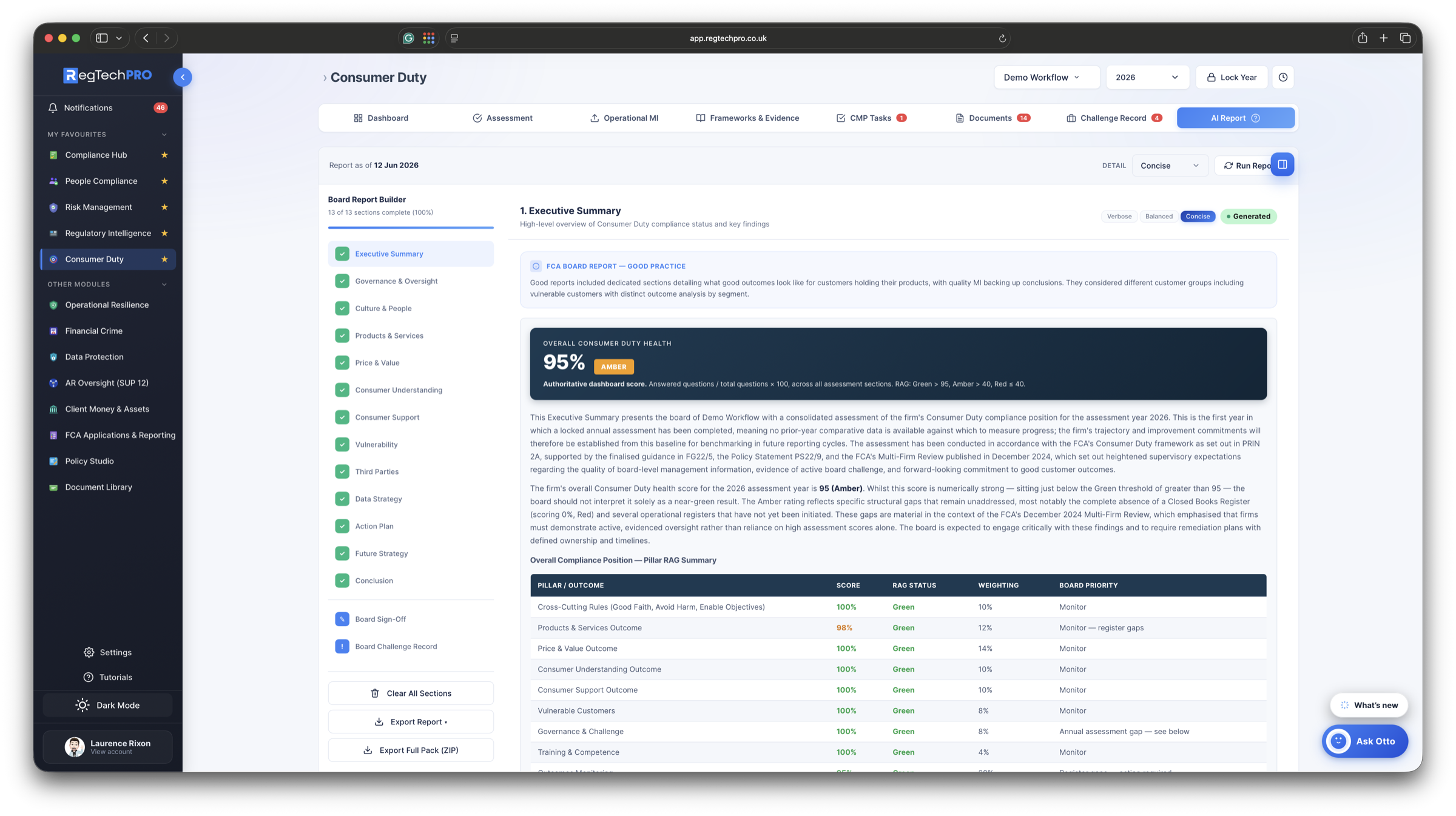
The 29-page PRIN 2A Annual Board Report drafted by Otto from your live data in seconds. An executive summary and an overall Consumer Duty health score, 13 sections plus Sign-Off and Challenge Record. Review, sign, export — board-ready, supervisor-ready.
Otto is the platform’s built-in compliance advisor, grounded in 150+ expert-authored documents. She reads your live monitoring, client-money and Consumer Duty records — not a generic handbook summary — and drafts the reports the regulator expects to see.
Your year’s monitoring drafted from live data across 13 regulatory anchors — coverage, findings and remediation, section by section.
A CASS oversight report grounded in your CASS 13 records — reconciliations, acknowledgement letters and breaches, read straight from the engine.
The 13 sections of your PRIN 2A.9 Annual Board Report drafted from your attested data in 60 seconds — review, sign, export.
Ask about your CMCOB obligations and Otto answers from your live records — which checks are overdue, where the file is thin, what closes the gap.
AI drafts, humans decide — nothing is auto-submitted, and every fact traces to your live firm data.
Three ways to run CMCOB compliance. Only one produces evidence the FCA can inspect — on the day they ask for it.
What a CMC director or compliance lead wants to know about platform-grade CMCOB compliance.
We use essential cookies to make the site work, and optional analytics cookies to understand how it's used. See our Cookie Policy.